


Our Enid published
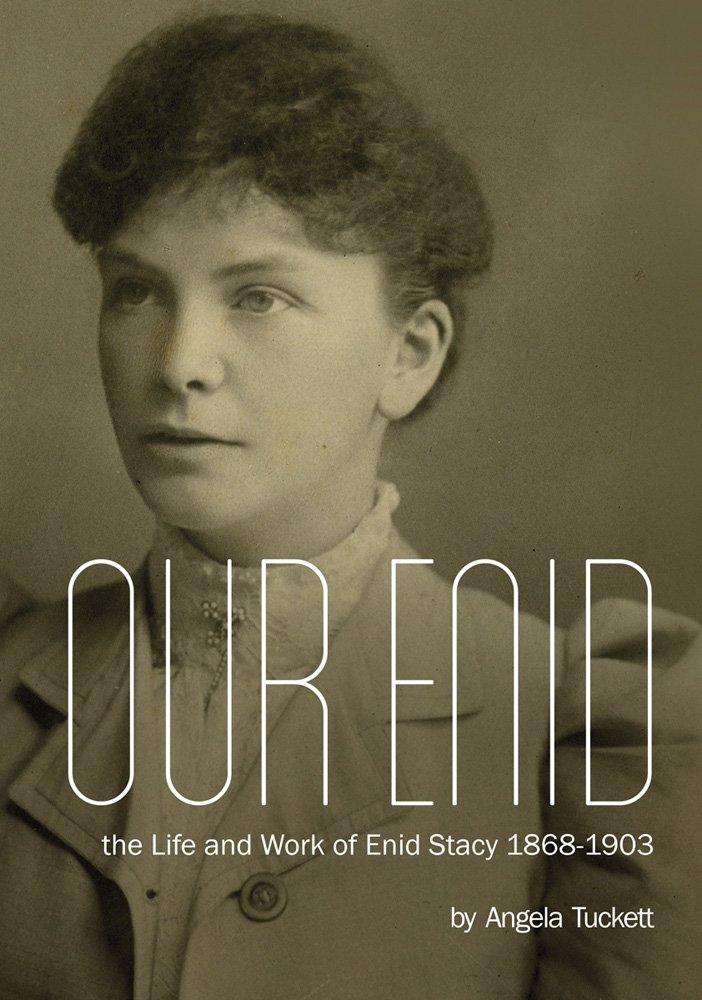 Biography of feminist and socialist Enid Stacy published.
This book tells the story of an inspiring public speaker who won over tens of thousands of working class men and women to the cause of socialism in the late nineteenth century.
Stacy spent her early years in Weston-Super-Mare where her father, a convinced socialist, was principal of the newly formed art college.
Their house was open to visitors from many different backgrounds who had also espoused socialism.
They entertained visiting socialists on an even more regular basis when the family moved to a Victorian villa in the Bristol suburb of Clifton, including Edward Carpenter, the poet and socialist William Morris, and George Bernard Shaw. She and her sisters often entertained the visitors by singing and folk dancing, which was closely linked to the new movements.
One of the first two girls from the newly-founded Redlands School to win a bursary for higher education, she went to University College Cardiff, where she graduated with a BA Honours degree. When she returned from Wales she soon became involved in meetings about the rights of working people, especially women.
Inspired by Miriam Daniell, women workers at a sweet factory went on strike after the owners of the factory announced a cut in wages and longer hours. The women already worked long hours and were locked inside the factory until they finished work.
Stacy joined the strike’s organising committee and worked intensely hard and helped the women campaign.
When they went back to work she was sacked from her teaching job; and after a spell at trying to live in a community in the Lake District, joined groups travelling with the Clarion Van to take socialist ideas to working people.
She toured the country – sometimes with the Clarion Van in Scotland and the North of England – to speak to large crowds.
To the Independent Labour Party (ILP), there was ‘no clearer [nor] more convincing exponent’ of socialist principles than Stacey, which led to the Fabians promoting her lecturing tours in America.
She shared platforms with contemporaries such as Keir Hardie, Eleanor Marx, and Tom Mann.
According to Mann, Enid Stacy ‘could speak to thousands in the open air as though she was talking with each one in their own home’. For this reason, she was known affectionately as ‘Our Enid’ and remembered for years after her early death by many who heard her.
At the prospect of war in South Africa Stacy took the view of the anti-imperialists and was against the war altogether.
After making speeches alongside Kier Hardie, Tom Mann and Fred Brocklehurst against the Boer war, Stacy was involved in the International Peace demonstration in Hyde Park, organised by Eleanor Marx and held before the International Congress in July 1896.
In Hyde Park there were 12 platforms arranged in a semi-circle. Stacy, representing both the ILP and the Social Democratic Federation (SDF), was on one of these (number 11) with the dockers’ leader, Tom McCarthy.
The six speakers all supported a resolution which declared that peaceful relations between nations are essential for progress; that wars are against the interests of working people and caused by capitalist and landlord classes seeking to control markets; and that peace, therefore, depends on the abolition of the system and its replacement by socialisation.
There were also calls for arbitration and an international eight-hour day to be established by law, and for universal adult suffrage.
Enid Stacy was only 35 when she died of an embolism while pregnant with her second child, in 1903.
Rae Street wrote about the life and work of Enid Stacy – whose contribution to the spread of early socialist ideas has often been overlooked – and her article was posted on the Independent Labour Publications website in 2013.
But there has never been a full-length biography of Enid Stacy – until this one, written by her niece Angela Tuckett.
But Angela Tuckett died in 1994, leaving the manuscript unpublished. It was the wish of the Working Class Movement Library’s founders Ruth and Eddie Frow that one day the biography would see the light of day.
After a lot of hard work bringing it up to a publishable standard in a way in which Angela Tuckett would have approved, everyone at the Library is delighted to see the end result: Our Enid – the life and work of Enid Stacy, 1868-1903. It is now available from the Working Class Movement Library’s bookshop.