


‘Sex education’ to be made mandatory
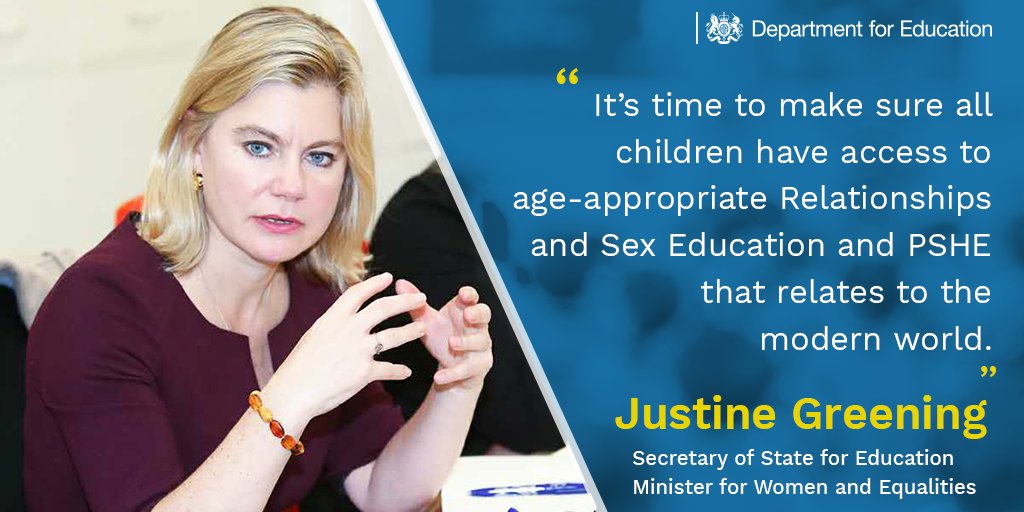 ‘It will be a requirement for all secondary schools in England to teach relationships and sex education.’
Justine Greening, the Education Secretary, has – at long last – set out plans for ‘relationships education’ in primary schools and ‘relationships and sex education’ in secondary schools in England.
The government has just tabled amendments to the Children and Social Work Bill which will make it a requirement for all secondary schools in England to teach relationships and sex education (RSE).
The amendments also allow the government to make regulations requiring ‘personal, social, health and economic education’ (PSHE) to be taught in all schools in England – primary and secondary, maintained and academy – in the future.
Relationships education, RSE, and PSHE are designed to ensure pupils are taught the knowledge and life skills they will need to stay safe and develop healthy and supportive relationships, particularly when dealing with the challenges of growing up in an online world.
Currently, only pupils attending local authority run secondary schools – which represent around a third of all secondary schools – are guaranteed to be offered sex and relationships education, and PSHE is only mandatory at independent schools. Neither are currently required to be taught in academies.
Young people, parents and campaigners have been calling for a consistent approach on RSE.
And a survey of 16 to 24 year-olds carried out by the Terrence Higgins Trust in July 2016 showed that 99 per cent of young people thought RSE should be mandatory in all schools; and 1 in 7 had not received even this kind of education.
The government is proposing to introduce the new subject of ‘relationships education’ in primary schools and to rename the secondary school subject ‘relationships and sex education’, to emphasise the central importance of healthy relationships.
The focus in primary school will be on building healthy relationships and staying safe. As children get older, and it is important that they start to develop their understanding of healthy adult relationships in more depth, sex education will be delivered in that context.
The current statutory guidance for RSE was introduced in 2000 and is becoming increasingly outdated – it fails to address risks to children which have developed in recent years, such as online pornography, sexting and staying safe online.
The government is already taking action to address this; a new internet safety green paper will be introduced later this year, which will set out a series of steps aimed at making the internet a safer place for young people.
This will be complemented by a comprehensive programme of engagement by the Department for Education (DfE) with what it refers to as ‘stakeholders’ to set out suitable, age-appropriate content on RSE which focuses on mental wellbeing, consent, resilience, age-appropriate relationships and sex education, and keeping safe online.
Regulations and statutory guidance will then be subject to full public consultation later this year, and the aim is to see children and young people being taught this new curriculum in schools by September 2019.
The amendments will continue to allow parents a right to withdraw children from sex education classes, and schools will be required to publish a clear statement of their policy and state what will be taught so that parents can make informed decisions about whether their child should attend such classes.
As is already the case where sex education is currently mandatory, schools will also be able to determine how they teach these subjects so they can ensure their approach is sensitive to the needs of the local community and, in the case of faith schools, in accordance with the tenets of their faith.
Which leaves a few issues hanging.
But, as Sarah Green, co-director of the End Violence Against Women Coalition, said: “This is a real step forward in ending violence against women and girls and we commend the government for listening to experts and responding.
“It opens the door to high-quality RSE that will let young people have the essential conversations about consent, respect and LGBT equality.
“Quality RSE is a chance to talk with young people about how men and women treat each other, and to challenge the attitudes which minimise or make excuses for abuse of women and girls.
“It is a chance to emphasise such violence is always unacceptable, whether on our streets or in our schools.”