


Political parties and tax justice matters
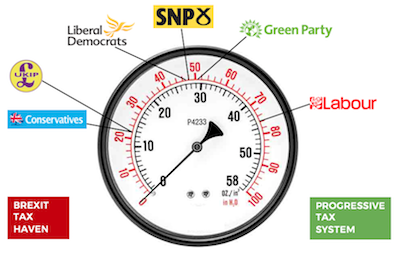 Do the parties advance, or reverse, an agenda that is compatible with the pursuit of tax justice principles?
Tax Justice UK, the newly launched sister organisation to the Tax Justice Network, released its detailed analysis of the general election manifestos of the main political parties recently.
It aimed to assess how far they advance, or reverse, an agenda that is compatible with the pursuit of tax justice principles and the public interest.
And it found that none of the parties will admit that, ten years after the financial crisis, the British economy is being run in the interests of a small financial elite based in the City of London, to the detriment of the rest of the British population and of many other people around the world.
In November 2008, the Queen visited the London School of Economics and asked why no-one had foreseen the largest financial crisis since the 1920s; in reality the warning lights had been flashing for years, but people in power chose to ignore the signals and failed to represent the public interest.
And the glib politicians’ assumption that the interests of the British people are aligned with those of the City of London could not be further from the truth.
The 2017 manifestos of the Conservatives, Labour, the Liberal Democrats, the Greens, UKIP and the SNP demonstrate varying levels of commitment to addressing tax avoidance and building a fair and progressive tax system.
Tax Justice UK analysed each manifesto in detail, assessing the extent to which they advance, or reverse, an agenda that is compatible with the pursuit of tax justice principles.
Tax Justice UK has scored their pledges on tax issues based on 10 criteria under four sub-headings:
1 – Tax avoidance and transparency
2 – The UK’s secrecy network
3 – Tax ‘competition’
4 – Tax fairness
And the scores? Labour leads the pack with a score of 76 out of a possible 100, followed by the Greens on 51, the SNP on 48, the Liberal Democrats on 47, and the Tories and UKIP both on 22.
Plaid Cymru was excluded because only local taxes are devolved to the Welsh Assembly, so their manifesto could not be fairly compared to the others.
Resourcing HM Revenue and Customs:
Only Labour have made a significant commitment to increase HMRC’s resourcing and its ability to tackle tax avoidance in a meaningful way, although the Greens come close.
A relatively small investment by the next UK government would yield significant financial returns as well generating political capital.
Clamping down on secrecy jurisdictions:
Both Labour and the Lib Dems plan to put pressure on ‘tax havens’ as part of their international development strategy, although Labour is specifically focused on the UK’s network.
The Conservatives do not make any mention of this, following their failure to cajole or compel Britain’s overseas territories and crown dependencies to embrace transparency in 2016, while UKIP are also silent and the Greens and the SNP do not present any detailed plans.
There is a clear ideological distinction between the parties here, with the Lib Dems and SNP taking a middle-ground position between Labour and the Greens on one side, and the Conservatives and (presumably) UKIP on the other.
Reducing business taxes is a form of tax ‘competition’, a policy that is based on flawed economics, and there is no evidence to support the argument that higher business taxes will be passed on to workers and consumers.
A corporation tax rate of 26 per cent would still be the lowest in the G7.
Labour and the Greens plan to actively increase taxes on unearned income; the Lib Dems will simply reverse recent cuts, while the SNP will support limited action across the UK.
UKIP will go backwards by increasing inheritance tax thresholds, while the Tories do not plan any changes.
Leaving aside the evolving Tory plans to use property wealth to fund in-home social care, the Conservatives have missed an opportunity to tackle inequality of wealth, rather than income.
The top 10 per cent own 45 per cent of wealth and the bottom 50 per cent own just 9 per cent. And as Phillip Blond recently wrote, “there can be no popular capitalism if people do not have capital”.
It is, Tax Justice UK said, striking that Labour, even in its most radical manifesto for decades, holds back from grappling with the choke-like grip that the City of London exerts on UK economic and fiscal policy, which, to quote TJN’s 2016 report, ‘has crowded out manufacturing and non-financial services, leeched government of skilled staff, entrenched regional disparities, fostered large-scale financial rent-seeking, heightened economic dependence, increased inequality, helped disenfranchise the majority and exposed the economy to violent crises’.
Will Snell, director of Tax Justice UK, said: “Ten years after the crash, little progress has been made. Household debt is at record levels.
“Air pollution levels are hazardous in our cities; climate change is unaddressed. Investment in productive jobs has not materialised.
“Market power has become concentrated in the hands of multinational companies who extract wealth without paying taxes on their vast profits.
“The majority of new jobs pay low wages and provide little or no job security. Housing is unaffordable.
“Wealth and income is unevenly distributed between a tiny minority and vast numbers who are ‘just about managing’.
“The UK’s financial system remains opaque, unaccountable and rigged to serve the interests of the 1%, not the 99%.
“The status quo is neither equitable nor sustainable, and it will only get worse if the threats to turn the UK into a ‘Brexit tax haven’ become reality.
“The next government must take it upon itself to run the country and the economy in the interests of the whole population, not just those at the top of society.”
To download the full 14-page report, click here.