


Gender and mental health problems
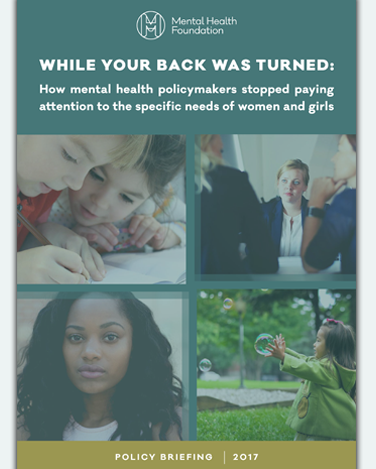 Fifteen years ago there was a government mental health strategy for women and girls.
Today … gender is almost entirely unmentioned.
Services specifically targeting the mental health of young women have become almost invisible in government policy in spite of evidence of a growing crisis, a new report says.
The report, by the Mental Health Foundation, and with the title ‘While Your Back Was Turned’, has revealed that services targeted to tackle mental health problems amongst young women are almost entirely absent from current government strategy.
This is in spite of the fact that mental health problems among young women are rising rapidly.
Women are currently three times as likely as men to have experienced common mental health problems; rates of self-harm have tripled among young women since 1993 and young women are three times more likely than men to experience Post-Traumatic Stress Disorder.
The report was released in the run up to Christmas – a time when many women are under increased pressure and can face particular mental health challenges.
And it says the root causes of mental ill health for women are often complex and gender specific.
This means that it is not enough to assume women will benefit from policies targeted at a general population.
Instead there is a need for gender-sensitive approaches that take account of the different issues affecting women and men.
The Mental Health Foundation believes that although there is no single solution for improving the mental health of young women and girls, the first step is bringing a gender sensitive approach to public policy and service developments needs to be the starting point.
The author of the report, Dr Amy Pollard, said: “The situation is getting worse.
“Fifteen years ago, there was a government mental health strategy for women and girls.
“Today, except for care aimed at new mums and mums-to-be, gender is almost entirely unmentioned.
“At a time when young women are facing a crisis in their mental health, there is a desperate need for targeted policy.
“We know how important mental health services can be to enable real recovery and prevent recurrence of ill health.”
“When it comes to things undermining women’s mental health, the weight of the evidence points to the role of issues like domestic violence and abuse, and the role of the online culture, social media and pornography,” Pollard continued.
“Austerity has hit women particularly hard, with House of Commons research showing that 86 per cent of the burden for recent cut-backs is falling on women.
“All of these things come together creating a perfect storm that adds pressure on young women and girls.
“The government’s recent Green Paper folds the mental health of young women and girls almost entirely within the broader envelope of ‘children and young people’, and makes no new financial commitments to specifically support women and girls.
“Instead we need new gender sensitive approaches that allow us to understand and tackle this growing problem amongst women,” Pollard said.
“The government has opportunities to remedy this situation, including ensuring that the Women’s Mental Health Taskforce delivers a comprehensive report with ring-fenced funding to invest in women and girls’ mental health.”
To read the report on young women and girls’ mental health click here.
Please forward a copy to your MP.