


UK cuts to funding of English language courses to hit women hardest
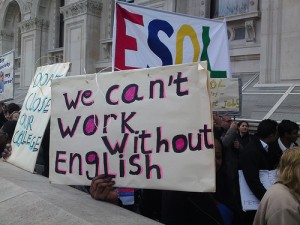 Summary of story from the BBC, May 18, 2011
Five years ago, single mother of four, Layla Abdi Nur, and her family fled the bullets and bloodshed in Somalia to come to London.
Ms Abdi Nur, 27, could not speak any English when she arrived from Mogadishu, but now, after two years of full-time language lessons at the College of North West London, she can make herself understood.
But she is still far from fluent.
“Now it is much better [than] when I started to learn at this college,” she said. “But when I meet the GP it is difficult to say what I need to ask them.”
Because of the government’s planned cuts in funding for English language learners, Ms Abdi Nur fears that she will not become proficient enough in English to fulfil her dream of one day becoming a nurse, coming off benefits and supporting her family.
According to the Association of Colleges (AoC), as from August, she will become one of 30,000 women in London on “inactive” benefits, which include income support and housing benefit, but mean no government funding for English for speakers of other language courses (ESOL).
The £1,280 annual fees are beyond Ms Abdi Nur’s budget, and so in August she will be forced to stop attending classes.
Last month, Prime Minister David Cameron said that in order to better integrate, immigrants should learn English.
Heidi Alexander, Member of Parliament (MP) for Lewisham East, points out that the ESOL cuts are at odds with the prime minister’s statements and she questioned their social impact.
Referring to the fact that it is particularly women who are at home looking after children, Ms Alexander said: “These changes will have a hugely disproportionate effect on women.”
“I’m all for people paying when they are able to pay, but these people are not in a position to be able to pay. It is very shortsighted,” she said.
Women make up more than two-thirds of all ESOL learners in England, according to the Association of Colleges.