


Gender influence less evident in work of female directors than authors?
 Summary of story from The Times of India, June 4, 2011
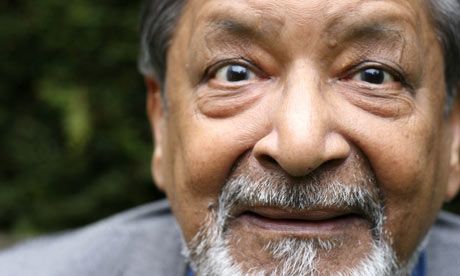
V S Naipaul, the Nobel prize-winning Trinidadian-British writer of Indian descent, recently described female authors, such as Jane Austen, as “sentimental” and “unequal” to him (see WVoN story).
In his misogynistic invective, Naipaul claimed: “I read a piece of writing and within a paragraph or two, I know whether it is by a woman or not. I think (it is) unequal to me.”
“This is because of women’s sentimentality, and their narrow view of the world. A woman, she is not a complete master of a house, so that comes over in her writing too.”
Now the debate has escalated to consider whether it is possible to determine the gender of a director from the first two scenes of a film.
Actor Tillotama Shome said: “V S Naipaul is highly gifted or deluded if he believes that he has the power to discern the gender of a writer after reading two stanzas.”
“I believe I can watch the first two scenes of a film and tell if it’s a film I would like to watch. A film does tell you about the film-makers politics and the restraints under which it was made rarely the gender of its maker. At least, I have no such rare talent!”
Director Bappaditva Bandopadhyay concurs with Ms Shome’s views on female directors, although he admits he sympathises with Naipaul’s attitude towards women’s writing: “I agree with Naipaul’s views on literature. When women write, they have a point of view which is different from that of men.”
“I am reading a novel by Sushmita Bose titled Single in the City. I can make out that it is written by a woman by the way men are described by the author.”
“But that’s not the case when it comes to cinema. While male directors have always explored the female body, I don’t find that honesty when female directors are exploring the male body.”
“In fact, female directors hardly explore the male body. I don’t see a feminine point of view when I watch movies made by women directors.”
So, following Bandopadhyay’s argument through:
All those scenes where Natasha Henstridge is naked in Species are about artistic honesty and not titilation.
The fact that the male gaze in film avoids exploring men’s bodies, is not because it might create some kind of sexual disorientation that would challenge male heterosexuality, but because the onus is on women directors to provide those explorations.
Because female directors don’t fill their films full of images of men’s bodies (which would be welcomed with open arms, because it’s not about the eroticism, but the honesty of the image) their films are less honest.
And this lack of honesty, which can only be expressed through an exploration of the body, means that films made by female directors have no feminine point of view, feminine point of view only being expressed through the image of a man’s body.
And I was afraid that this debate might be banal.
Naipaul’s comments are Infuriatingly narrow-minded and Bandopadhyay splendidly naive. They should be forced to read a book on gender and film theory – The Routledge Critical Thinkers series by Shohini Chaudhuri for instance. This would put their ignorance to shame.