


Women’s soccer success embraced by post-tsunami Japan
 Summary of story from CNN, July 15 2011
Japan will take on the United States in their first appearance in a World Cup final this Sunday in Frankfurt, Germany.
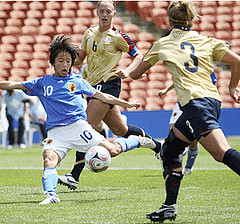
Japan’s surprise triumph over Germany last week to qualify for the final has provided a much needed boost to the country following the recent devastation caused by tremors and the subsequent tsunami.
It is also putting women’s sport in the spotlight.
Andrew McKirdy, sports writer for English language newspaper Japan Times, said the success of the women’s national soccer team has reinvigorated a nation dogged by recent tragedy.
“The women take a lot of pride in the fact that everything is staked against them,” McKirdy said.
Tom Byer, a youth soccer instructor in Japan for over 25 years and former coach of starter Aya Miyama, has welcomed the team’s success as “a breath of fresh air, because everything out of Japan has been negative over the last few months”.
The women’s national team, Nadeshiko (meaning “beautiful flower”) has been the underdog throughout this year’s tournament.
Whilst Nadeshiko may not prove a match for the US team, who have triumphed in the 1991 and 1999 World Cup tournaments, Byer has highlighted the international success of the team elsewhere over the past 20 years.
As well as finishing fourth at the 2008 Beijing Olympics, Nadeshiko has appeared in each of the six women’s World Cup tournaments since 1991, and triumphed at the 2010 Asia Games in Guangzhou, China.
However their accomplishments appear not to have significantly impacted on the women’s game in their home country.
The number of young girls interested in playing organised football has not increased. There are just 25,000 girls registered to play youth soccer in Japan, a country of more than 125 million people.
This compares to roughly 200,000 girls registered with the American Youth Soccer Organization in the US State of California alone.
This could have financial implications, as women’s soccer is grossly underfunded.
According to Byer, it wasn’t until five or six years ago that the Japanese Football Association (JFA) got together and decided to put more resources behind women’s soccer
In fact, many players from the national team even have day jobs: “Aya [Miyama] and some of the other players from the team are from Nimasaka, a hot spring town. A lot of those women work in the hot spring resort hotels during the day, after the job they go and train,” said Byer.
Byer believes their success may be attributed to a national attitude towards sports and competition.
“It’s not like New York, where you play soccer from the summertime until Thanksgiving,” Byer continued. “In Japan, you play 365 days a year and you play only one sport. And you train and train until you fall down.”
Women’s youth soccer in the US, especially for girls under 12, is “purely recreational,” he said. In Japan “they are already trying to find who can be on the national team at the age of 12.”
Following the tournament has been awkward for many fans, due to the time difference between Japan and host country Germany.
Despite this sports fans are supporting their national team.
“I’m so happy. I was moved very much that Nadeshiko Japan played such a great game,” one Japanese male fan told CNN, following the team’s semifinals win against Sweden. “I want Nadeshiko to let us dream again at the final game.”