


The perfect princess, with her far from perfect story
 Alicia Duffy
Mother and blogger
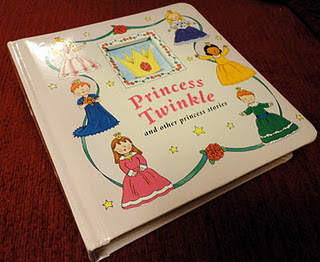
When my four year old daughter showed me her latest school library book – “Princess Twinkle and Other Princess Stories” – I cringed a bit, but settled down to read it with her.
She had chosen it herself, and while most of the book was far from what I would want my daughter to read, I just hoped it wouldn’t be too bad.
“The Perfect Princess” features Princess Poppy, a very messy little girl, pictured climbing a tree in jeans and a t-shirt. True, she has long loose hair, a crown and appears to be wearing lipstick, but overall she is dressed like a normal little girl.
Wonderful, I thought – this must be the story where all the stereotypes that have made up the rest of the book are challenged.
Cue a picture of Poppy at the breakfast table, when her parents tell her there is to be a garden party. Poppy asks to wear her jeans, but her mother refuses, saying she has to look like a “proper princess” and be “pretty”.
So, is this the part of the story where the princess shows everyone that it is more important to have fun than dress up, I wonder?
Maybe there will be an amusing incident where a “pretty” princess rips her dress, but doesn’t care, because Poppy has shown her how to have fun climbing trees or whatever?
We then watch Poppy getting ready for the party, putting on her t-shirt, jeans and trainers, then giving herself the thumbs up in her mirror, saying she doesn’t care what people think, because being a messy princess is more fun. Great.
As she stands in front of the mirror, her posture is strong, she is smiling at herself and she is surrounded by her sports equipment. She looks confident and happy. This story could go well.
But not for long. As Poppy leaves the palace to go to the garden party, she spots Prince Harry.
As soon as she sees him, she decides that she doesn’t want to be a messy princess any more and runs back inside, where she changes into a frilly dress and high heeled shoes.
When she returns, Harry is enchanted, calls her beautiful, kisses her hand and invites her for a game of croquet (yes, croquet!).
Even worse, the children are pictured surrounded by love hearts.
So, here is the reward for changing how she dresses – she gets the guy.
We don’t know if she changes how she behaves, beyond the picture of her playing croquet nicely on a lawn instead of climbing a tree.
The last picture features Poppy’s parents looking on approvingly. “At last, Poppy had become a proper princess!”
The rest of the book was bad enough, but this story was so blatant it shocked me as children are so impressionable at this age.
They are discovering where they fit in the world, what is expected of them, what to aim for.
The purpose of Poppy, as far as I could tell, was to show my daughter that she should forget about playing active sports, having fun, being her own person, and should focus on getting herself a nice man.
Instead of being a confident, beautiful girl, in clothes that make her feel comfortable and allow her to play football and go skateboarding, Poppy’s story served only to tell her that she was not suitably dressed to be at a party with a boy.
Worse still, the way to get this man was to change everything about herself. Messy is bad. Fun is bad. Pretty and sweet is good.
I can only assume that this book found its way into the school library by accident, although, unbelievably, it has been in circulation since 2003.
But not for much longer, if I have anything to do with it!
Oh dear, oh dear, oh dear…
Best of luck getting the book shelved somewhere less conspicuous. Try replacing it with this http://www.goodreads.com/book/show/392830.Not_One_Damsel_in_Distress 🙂
Oh dear, oh dear, oh dear…
Best of luck getting the book shelved somewhere less conspicuous. Try replacing it with this http://www.goodreads.com/book/show/392830.Not_One_Damsel_in_Distress 🙂
(P.S. it looked like the page ate my comment the last time I tried to post it, apologies if it shows up twice now)
My favourite book as a young child was The Tiger Who Came to Tea. I was nostalgically delighted to see it among my niece’s first books, and then horrified as I read it to her. I guess I missed the rigid gender roles the first time round, or rather I didn’t miss it, I’m sure it lodged as firmly in my consciousness as it did in other young readers. In early childhood we learn that authority is male, and until children stop learning that, until it is rooted out of every pretty princess book, then all the quotas in the world won’t get us equality. I say give them hell, Alicia.