


Blue Ventures – empowering women in Madagascar
 Ruth Rosselson
Freelance writer
Population growth is in the news as the world’s population reached seven billion this week.
As the debates over the planet’s ability to cope with rising populations continue, many of the world’s rural people are already familiar with the impact of population growth on their local environments.
Madagascar has one of the world’s fasted growing populations, with an average fertility rate of over five births per woman.
Despite the government pledging to increase and promote family planning, the population of Madagascar is still expected to double within 20 years.
Such growth exerts huge pressures on Madagascar’s natural resources – both land-based and marine – and threatens the survival of the islands unique flora and fauna.
Whereas contraceptive services might be easily accessible for women in Madagascar’s large towns and cities, for rural villages, it’s a different story.
Women in the southwest coastal village of Andavadoaka, used to have to face a 50km journey to the nearest town to access contraceptive services.
Many women were having their first child before they reached 18 – some having them as early as 13. Meanwhile, families of 10 children, or more, were commonplace.
Blue Ventures, a marine conservation charity working in the village of Andavadoaka, set up its first sexual health clinic in 2007 as a direct response to initial research and consultations with women and men from the village.
Rebecca Hill, Project Manager for Blue Ventures Sexual and Reproductive Health programme worked in the clinic during 2008.
“I often saw women who already had eight or more children and were desperate to stop”, she said.
Four years on and the effects of the programme are starting to be seen, with condom use in Andavadoaka now up to 36% (up from 9.4% in 2006), contraceptive use up to 40%, and a drop in the birth rate by a third. The programme has also expanded to over 20 other villages in the region.
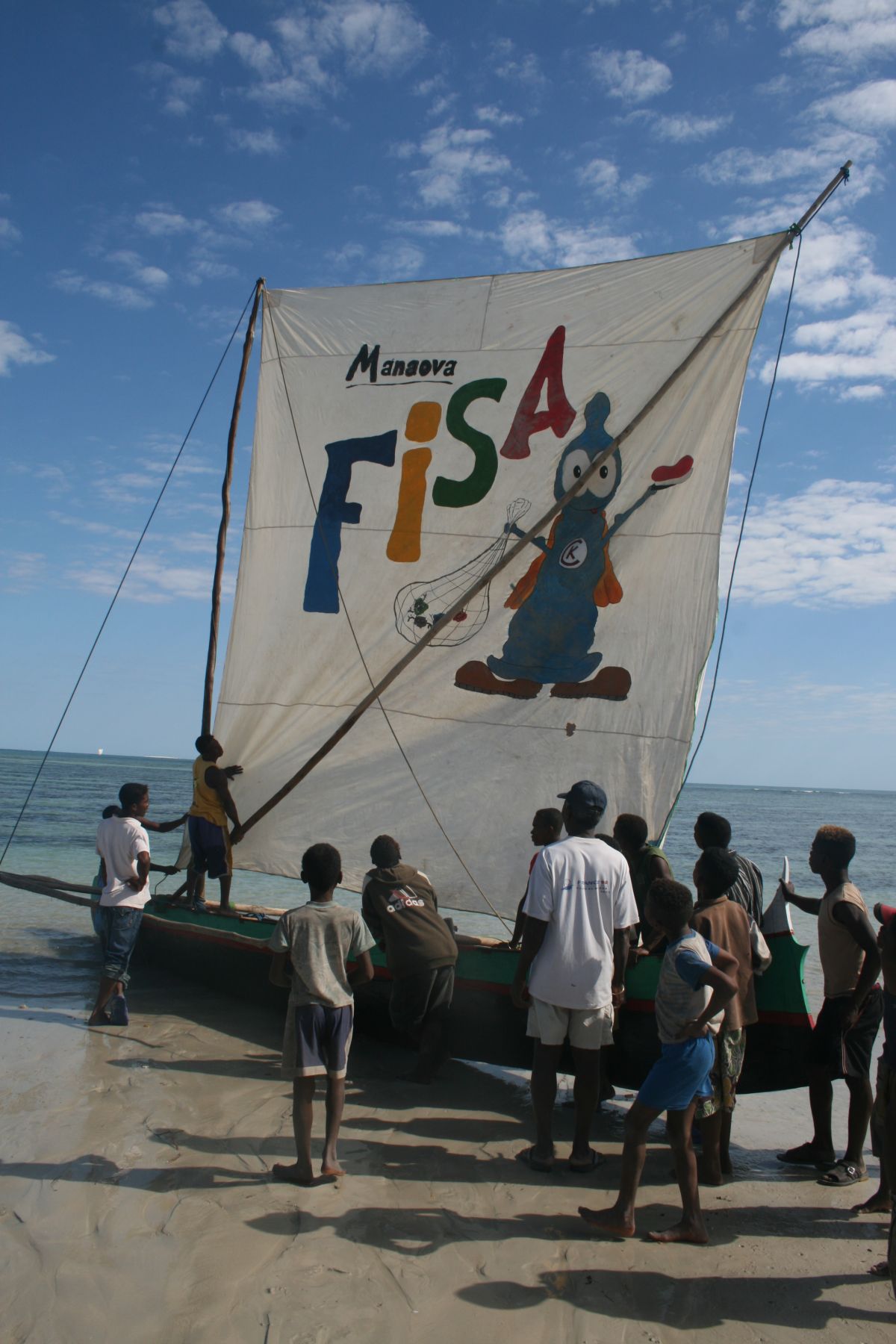
Distribution of contraceptives and of health education is quite a challenge in villages as remote as these. There are no paved roads, no public transport and the main mode of transport is the sailing canoes, which are at the mercy of the weather.
To try and increase the reach of the programme, Blue Ventures has worked to implement a programme of community-based distribution.
Community members are recruited and trained to distribute a limited range of contraceptives, offer basic health education and contraception counselling.
What’s also been instrumental in the programme’s success is that it has used innovative, fun and entertaining methods to educate and raise awareness about sexual and reproductive health. So far, theatre, peer-lead education, cinema and sporting events have all been used.
Meanwhile, the staff sail to satellite clinics within the region in a special sailboat, with the programme’s mascot – Captain Kapoty (Captain Condom) – proudly displayed on the sail.
For Blue Ventures, integrating family planning into all of its conservation work is essential. The marine and land resources in the region are already suffering from environmental pressures such as climate change.
Population growth adds to those existing pressures, as more and more people are competing for ever decreasing resources.
“Marine resources are running out” says Maso, 32. “If we keep giving birth so frequently, there won’t be any food left for us and we’ll suffer. Using family planning allows us to limit our births so that does not happen”.
Yet, family planning is not just about promoting the use of contraception, or just about decreasing controlling the population.
It is about empowering women to take control over their fertility, their health, their bodies and ultimately their lives.
“My parents have nine children” says Zaina, 16. “They can’t support my education. Family planning means that I can protect myself from early pregnancy, and when I have a husband, I can choose when to have children, and how many”.
This is a fantastic feature and a fascinating read. It is amazing to see how programmes are adapted to suit different needs around the world. Thanks for bringing our attention to this!