


Well behaved women rarely make history: women in democratic transition
 Rosy Moorhead
WVoN co-editor and features editor
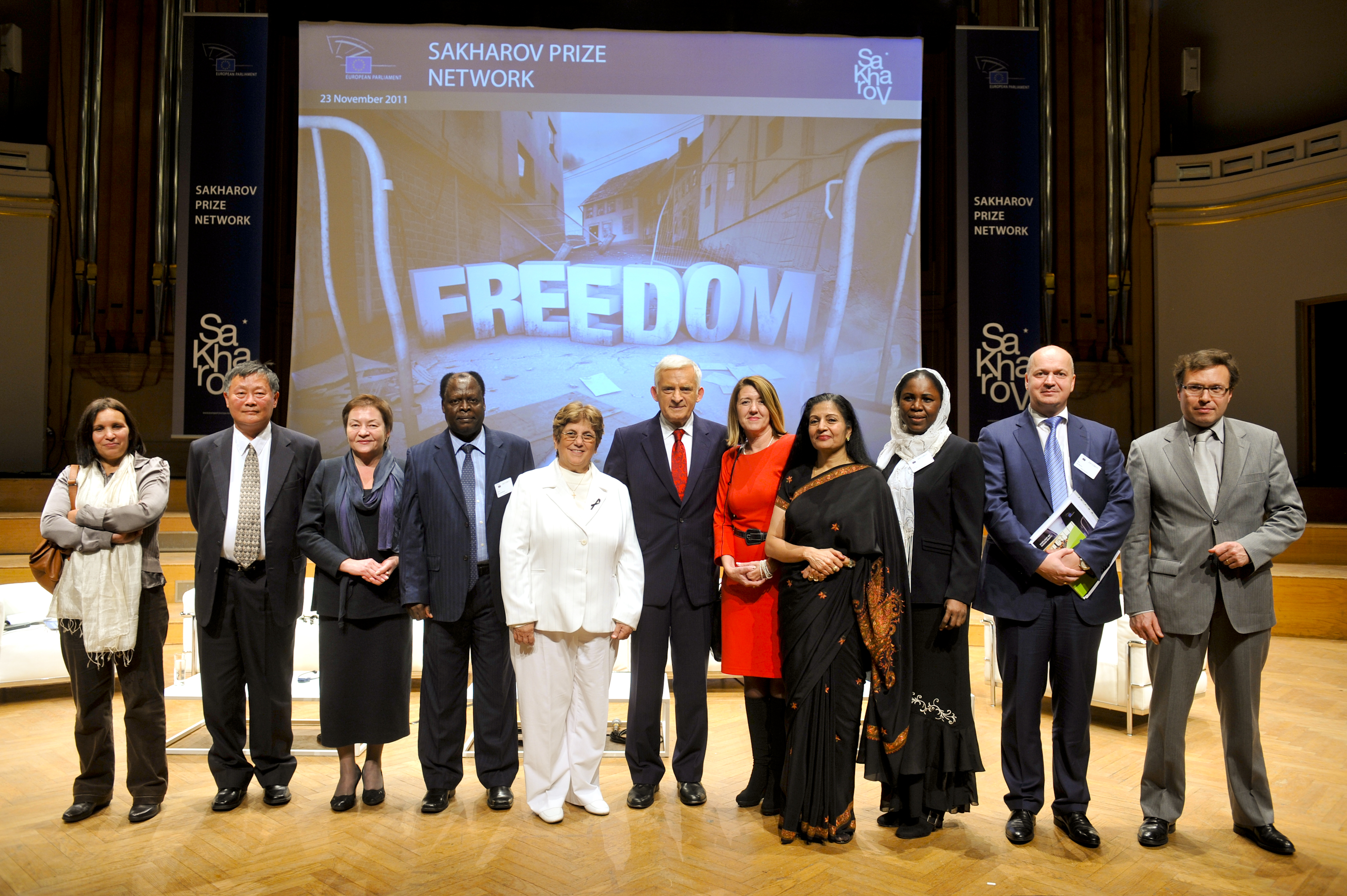
On a grey, wet day last week, I was in a damp crowd of journalists and photographers shuffling our way through the security check at the European Parliament’s headquarters in Brussels.
As I reached the door, a diminutive Chinese woman gently but firmly pushed past me to get to the front. I glanced down and noticed the slogan on her hemp shoulder bag.
Well behaved women seldom make history.
The entire press team of the Parliament couldn’t have come up with anything half as good to sum up the spirit of the Sakaharov Prize laureates, women and men, that we were there to honour.
I gave an appreciative chuckle and moved aside for her.
The prize
The Sakharov Prize for freedom of thought, named in honour of the Soviet physicist and political dissident Andrei Sakharov, has been awarded by the European Parliament every year since 1988 to individuals or organisations that have shown great bravery and courage in fighting for human rights or democracy.
As well as the invaluable recognition and backing of the Parliament, the winner also receives an award of €50,000.
Laureates include Taslima Nasreen, the 1994 winner, who fights the oppression of women and religious fundamentalism in Bangladesh; Leyla Zana (1995), the first female Kurdish MP and a former political prisoner; and Aung San Suu Kyi in 1990.
This year, the prize goes to five representatives of the Arab Spring, who will be presented the award at the Parliament’s formal session in Strasbourg on December 14.
The role of women in democratic transition
Today we were gathered to discuss the role that women can and should play in transition.
In her welcoming address, Isabelle Durant, vice-president of the European Parliament, said:“The female laureates here tonight have played a very important role in their countries’ transitions.
“But many more women than are here tonight have played a part. We are obliged to continue working to honour all women who have died in terrible circumstances.”
Taking the stand, European Parliament President Jerzy Buzek said: “Today women are in a worse position statistically than they were at the 1995 Beijing Conference on Women. We need real equality, not just formal equality: it isn’t enough just to declare it in a constitution.
“The Arab Spring has put the issue of women’s rights at the heart of democratic transitions. Women have played crucial roles in the revolutions.”
On the subject of women being catalysts for change, Algerian laureate Salima Ghezali, the journalist and women’s rights activist, said: “Women have a vital contribution to make. They have for over a century.”
She said that when violence formed part of a country’s development and transformation, people tended to regress to the way things had been done before, with the result that women became marginalised back into the private sphere.
This happened in Syria and Bahrain, she said, as well as in her own country.
“Feminists were the first to come out onto the streets. Then tens of thousands came out to protest against the government.
“Then the Islamists said it was a sin for women to come out in this way. That brought out even more women! But then fear crept back in and the women went back home. It was very sad.”
Speaking by phone from the middle of the turbulence in Cairo, and mere hours before she was beaten, arrested and sexually assaulted by the Egyptian police, activist Mona Eltahawy said that women in her country had been present in the revolution from the very beginning.
“We need a cultural and social revolution for the political revolution to survive. Women were overlooked in March when the military put together a committee for the constitution. Women need to be involved in all aspects of a new Egypt.
“They are fighting and dying alongside men.”
In a statement read out on her behalf, UN Women’s executive director, Michelle Bachelet, said: “True democracy without the participation of women isn’t possible.”
To achieve this, she said three things were needed: the removal of obstacles to participation; women having a real voice; and democratic institutions being truly accountable to women.
“Women’s rights must be formally institutionalised into law. Let’s work together to keep the momentum strong.
“Just as a bird needs two wings to fly, so a society needs women and men leading together to evolve to a higher level.”
Rights and responsibilities
On the subject of women’s rights in times of change, Lakshmi Puri, the UN’s executive director and assistant secretary-general for intergovernmental support and strategic partnerships, highlighted the relationship between women’s rights, human rights and democracy.
“Women’s participation in politics is fundamental to democracy, sustainable development and peace. A political system which neglects women’s rights will not become a democracy.
“Women are 3.5bn citizens but face a wide range of constraints against their participation. Less than 10% of world leaders are women. Women are held back by traditional gender stereotypes: they are not seen to be ‘born leaders’.
“But they must be in all three parts of democracy: the judiciary, the executive and parliament. For everyone’s good, for society’s good. The quality of democracy is substantially changed when women are involved in political life.
Gender equality is all of our responsibility, she concluded. Equality has to come now and it has to be front-loaded: it can’t be added on as an afterthought.
“May women triumph in their fight for equality, and also for democracy.”
Hauwa Ibrahim, the 2005 winner, said women in Nigeria really felt supported in their role in democracy.
“But can more be done? Without a doubt. We need more women in politics, more women to take the initiative in change. There is hunger and thirst for these core values, mainly in the women.”
But she said that, as well as rights, women also had a duty. “Women have the responsibility to instil in the children these core values.”
Ibrahim is one of the few women lawyers fighting for human rights and against religious fundamentalism in Nigeria.
The situation in Bosnia-Herzegovina did not look promising according to journalist Vildana Selimbegovic.
She said change was now happening in the country but only very slowly. One year after the elections, still no government has been formed.
“Women could play a role in this,” she said. “We need women in the political process.”
But, as things stand, women are not in leading positions in any political party. She suspects women have been unable to rise to the higher levels of society because of traditional social and political divisions.
“Women don’t have the opportunity to fight against conservative ideas and opinions.”
So now what?
A diverse group of people gets together to discuss their firsthand experiences of human rights abuses at times of transition.
They and the audience agree that women have and must play a vital role in such transitions, and that true democracy cannot be achieved if the needs and rights of half of the population are not written in to the change from the very beginning.
Listening to and being in the presence of these women and men, who have been through so much, was humbling yet terrifically inspiring.
But I couldn’t help but look at who the audience was made up of – mainly white, highly educated, comfortably-off European women – and wonder if all this wasn’t simply preaching to the converted.
I look forward to the day when there is a far more diverse audience who have decided to attend such a conference. And the day when such a conference is held outside of Europe and has been organised by non-Europeans.
Though, of course, what I really wish for is the day when such a conference is no longer necessary.
Until then, I suppose, we will continue to need conferences peopled by ‘badly behaved’ women.