


Egyptian women frustrated by slow progress in post-revolution Egypt
 Summary of story from BBC News, January 6, 2011
Women participants in the Egyptian Revolution of January 2011 say they are frustrated that the progress promised by the Arab Spring appears to have stalled.
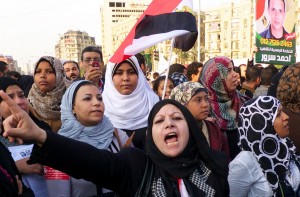
In the 18 days that brought down former President Hosni Mubarak, Egyptian women were out in Tahrir Square day after day, facing the brutality and violence of Mubarak’s police.
Now women are starting to believe that the optimism of the early days of revolution was misplaced, and that women’s rights are still not secure in post-revolutionary Egypt.
One of the catalysts for this concern has been the emergence of stories of widespread mistreatment of women by the military police of the Supreme Council of the Armed Forces (Scaf) that is currently ruling Egypt.
The precariousness of women’s rights in the new postrevolutionary Egypt became clear just three weeks after the fall of Mubarak’s regime, when hundreds of women taking part in International Women’s Day celebrations in Tahrir Square found themselves being shouted down by groups of men, who claimed that this was not the time to be discussing women’s rights.
Among the women present was Sally Zohney, a Twitter activist and youth project organiser for UN Women.
Zohney argues that the idea that this is “not the right time for women” doesn’t make sense. “Women have been there taking part from the very beginning of the revolution,” she says.
The day after International Women’s Day, the square was cleared and hundreds of people arrested, including 17 women. The physical abuse and “virginity tests” inflicted on these women by the Egyptian army now rank among the most notorious crimes of the revolution (see WVoN story).
One of the women forced to undergo a test, Samira Ibrahim, has since sued the Egyptian military council to ensure that they never happen again.
The atmosphere seemed full of optimism once again by November’s parliamentary elections, with many women queuing outside polling stations to cast their vote.
“It’s the first time I have voted in an election where I didn’t know the result beforehand,” said an anonymous woman.
Yet again, the results of the election brought dismay to Egypt’s women, as the Muslim Brotherhood’s Freedom and Justice Party (FJP) took the largest share of the votes.
Even female supporters of the Brotherhood are concerned about the lack of women in parliament and the message this sends about women’s role in society.
“I feel bad about that because people must know that women have a bigger role to play in political life,” says Sarah Mohamed, a young supporter of the party. “Women can do more than just stay home and raise children.”
Still the women of Egypt refuse to be cowed. In December, thousands of women and men took part in the biggest women’s rights rally in decades, to show solidarity with a woman whose clothes were torn off by Egyptian police in an image that has since become iconic (see WVoN story).
Sally Zohney still believes that the spirit of the revolution can achieve the goals that it promised for women.
“Women have to earn whatever rights they demand,” she says. “We have to fight for our rights, no-one is granting rights, rights are earned. The 25th of January taught us that.”