


World Economic Forum agrees on importance of women’s education and leadership
Credit - Moritz Hager
Jackie Gregory
WVoN co-editor
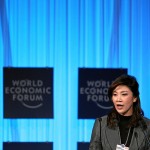
Thailand’s prime minister Yingluck Shinawatra is creating a national women’s development fund to counter human rights abuses against women.
Shinawatra, who was elected as the country’s first female prime minister last July, said that education is essential in equipping women to resist sexual aggression and to defend their rights.
She made the announcement at the World Economic Forum in Davos, Switzerland at a session focusing on women as leaders, which ended yesterday.
Shinawatra said gender inequality needed to be tackled at the grassroots to change perceptions:
“I support the idea of girl effect. When you educate a girl, it is valuable and creates a strong contributor to society in the future. Statistics show that when women have had education the opportunities for sexual violence against them will be reduced.”
Michelle Bachelet, head of UN Women, and former president of Chile, said education saved lives.
“When we invest in girls’ education we see an important drop in early pregnancy and so a drop in maternal mortality.
“The majority of maternal mortality in developing countries is in girls 15 years to 19 years. It will diminish early forced marriage and the incidence of HIV and viral aids.”
If a girl stays on at primary school for an extra year then she will see a 10 – 20 per cent boost in her eventual wage, if she stays an extra year at secondary school then she is likely to earn 15 – 25 per cent more in future wages, said Bachelet.
In a speech earlier in the week, the United Nations Secretary General Ban Ki-Moon, agreed, saying it was “the right thing to do and the smart thing to do for national economies and global stability” (see WVoN story).
Archbishop Desmond Tutu said if girls were not educated then “we could kiss goodbye to six of the eight millennium goals” including ending poverty, universal education and gender equality.
“Why don’t we get into our heads that the solution is straight forward. It is simple: we won’t make it without the women. It is part of who we are,” he added.
The chief operating officer of Facebook Sheryl Sandberg referred to an ambition gap.
“In the developing world, we have an ambition gap at societal level. We say we want to educate our girls as much as our boys but we don’t really mean it. We don’t really do the things we need to do.
“In the developed world we have an ambition gap at a personal level.
“Women have stopped making progress at the top in the last 10 years. There is still complete stagnation.”
She pointed to research that has found that, when asked, only 37 per cent of women in the US identified as very ambitious.
This compared to women in developing countries, who, despite barriers to education, were more ambitious with 59 per cent of women in Brazil saying they were very ambitious, 66 per cent in China and 85 per cent in India.
She despaired at the US chain store that sold T-shirts which said “Smart like daddy” for the boys and “Pretty like mummy” for the girls.
“This was not in 1951, this was last month,” she said. “We try to equalise things in the workforce but we have not equalised things in the home.”
Sandberg wants equal paternity and maternity rights to give men the chance to be more involved at home, and so women then have more chance to progress in the workplace.
Archbishop Tutu added that legal and societal barriers had to be removed and likened gender discrimination to racism.
“I have lived in a society which judged me on something silly which was the colour of skin.
“They legislated us and lo and behold they have not invested in us, they have not asked us how we feel about whatever, they have pontificated about us and we are doing the same with women …
“Remove these artificial barriers and the world discovers hey there is in fact a Nelson Mandela coming out of this community. I believe we are impoverishing ourselves when we do what we do to women.”
Although this was the 42nd World Economic Forum (January 25 – 29), it was the first one at which the question of women’s leadership was addressed.
Female participation in the world forum itself has increased from nine per cent ten years ago to 17 per cent this year.
A video of the discussion can be seen via this link.