


Irish conference on sex trafficking advises law change
 By Hazel K Larkin
WVoN co-editor
‘It’s a gender issue – not a repression issue, viagra ampoule ’ Monica O’Connor, case who – along with Dr Jane Pillinger – evaluated the Dignity Project, abortion told me yesterday.
She was one of the keynote speakers at the “Lessons from Dignity Project” conference in Dublin, an EU-funded project on trafficking and prostitution.
‘Some feminists have taken the stance that prostitution is a job, a choice, for many women. That isn’t true. All prostitution is violence against women.’
Over the past two years, Dignity explored good-practice models throughout Europe that could be replicated across EU member states so that victims of sex trafficking could be afforded better services.
In addition, it sought to examine what measures could ultimately reduce sex trafficking. According to a 2009 report, there are over 1,000 women and girls subjected to commercial sexual exploitation. The majority of these women and girls are migrants.
Talking about the strides made in Glasgow towards curbing the sex trafficking industry, Ann Hamilton – Head of Equality and Women’s Services in Glasgow – agreed with O’Connor.
‘We need to challenge the notion that prostitution is a harmless thing. We need to explode the myth that prostitution is acceptable. It’s not.’
Another myth associated with prostitution is that it is a transaction between a paying customer and a service-provider. In order to tackle the problem of prostitution in Glasgow, Hamilton’s agency decided to focus on the customers – the men who buy sex – and report the damage that prostitution does to them.
‘Men’s experiences of buying sex were not positive ones,’ Ms Hamilton said. ‘They spoke about feelings of guilt, shame and of wishing they had been stronger; of wishing they had been able resist peer pressure.’
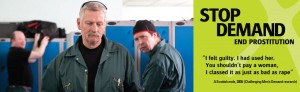
The current campaign being run by the Glasgow Community & Safety Services uses posters to convey the message that men do not benefit from prostitution.
In a society where men can buy women, children and other men for the purposes of sex, that society has no business talking about itself as an equal society. Prostitution – and the modern-day slavery that is using trafficked women as prostitutes – is caused by, and perpetuates, gender inequality.
‘In prostitution,’ Monica O’Connor continued. ‘The only person who has a choice is the man who is paying for sex. Women do not choose to become prostitutes. We need society to realise that exploitation of women is unacceptable.’
Yesterday’s conference also heard from Patrik Cederlof, Sweden’s National Co-ordinator against Prostitution and Trafficking. Based in Stockholm, Mr Cederlof shared experiences of his country’s success in combating prostitution.
The Swedes introduced legislation against the buying of sexual services in 1999 and have updated it recently. The main thrust of the legislation focuses on the criminalisation of the buyer of sexual services – not the women who are being used as prostitutes.
Since December of last year, the sentence for buying sex is twelve months in prison. The success that Sweden has had with combating the problem is one that could be emulated in Ireland.
‘The pimps themselves tell us that Sweden is bad for business,’ Mr Cederlof said at the conference.
Mr Cederlof refuted the criticisms of those who detract from the Swedish model. Critics claim that the Swedish laws just force the problem underground.
‘It doesn’t go underground,’ Mr Cederlof said. ‘We find the prostitutes – and the pimps – the same way the customers do. We follow and we find.’
Grainne Healy, who co-ordinated the Dignity Project, said that the ‘Dignity Project has highlighted the effectiveness of the Swedish legislation with the Department of Justice.
Irish officials have travelled to Sweden to assess the effectiveness of the law. Such a law, which does not have any significant Exchequer implications, would send a very clear message to those who traffic women and who buy sex that Ireland – as a society – does not tolerate such exploitation.’
With elections looming in Ireland, it is hoped that the new government will make tackling trafficking and prostitution a priority. ‘We certainly hope that a prohibition on the purchase of sex is a priority for the incoming government,’ Grainne Healy said.
The light of common sense …!