


Anti-Wal-Mart Coalition formed to stop African expansion
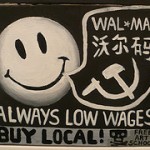 Summary of story from The Huffington Post, May 11, 2011
An Anti-Wal-Mart Coalition converged this week on Pretoria, South Africa, where a government office known as the Competition Tribunal is considering a mega-acquisition of MassMart by American retail giant Wal-Mart.
MassMart owns roughly 290 stores in 13 African nations, and has been described as “the perfect African entry vehicle” for Wal-Mart.
The coalition, which includes the South African Commercial, Catering and Allied Workers’ Union (Saccawu), and the South African Clothing and Textile Workers’ Union (Sactwu) is against the plan.
Sofia Scasserra, an economic advisor to the Argentine Federation of Commerce and Service Workers (FAECYS), provided one of the most stark statements to the tribunal.
She predicted that Wal-Mart’s worst impact would not be on wages but on the nation’s supply chain, and would result in “a detrimental effect on the business middle class.”
Wal-Mart does not take ownership of the goods until the product is sold, so suppliers bear the cost of unsold merchandise, forcing them to wait at least three months to get paid, she said.
It has also used a trade agreement between China and Brazil to import Asian goods into Brazil, allowing it to then import the merchandise into Argentina protected from tariffs.
All these strategies, said Ms Scasserra, make local producers unable to compete, and many companies have closed.
These anti-supplier policies mean that “small producers are often left out of the equation,” Scasserra explained.
Wal-Mart, she concluded, cannot be counted on to support “a local sustainable supply chain.”
She also described labour relations with many of Argentine’s unions as “troubled.” In one case, Wal-Mart laid off its union workers and hired new workers from subcontract agencies.
Group collective bargaining should be imposed as a condition, she said, and Wal-Mart should be obligated to purchase the goods up front, and be limited to 30 days of credit.