


Science – men only?
 Lindsay Keith
WVoN co-editor
The Guardian May 15, 2011
Institutionalised male boorishness is one of the reasons that females are under represented in science programming on TV.
Not only that, but it causes a feedback cycle because women are repeatedly under utilised as role models for STEM (science, technology, engineering and maths) subjects in the media.
In my experience as both a former scientist and a TV producer, the media ought to work harder to get more women in front of the camera in subjects that are traditionally seen as male-skewed.
Women are already woefully under-represented in science in everything from higher education to careers. This is reflected in the popular media.
So broadcasters – particularly those with a public service remit – ought to be doing everything they can to ensure that women and girls are better represented across the board in science-related broadcasting, but paying particular issue to the 5-16 age group.
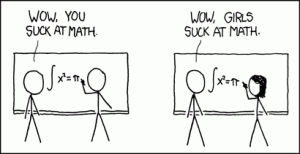
The problem is that the rot starts with girls’ expectations of themselves in science, maths and engineering fields at an extremely young age.
If you ask girls to take a maths test but ask them to tick a gender box first, they will perform less well than boys.
Girls, it seems, do not learn that they are not as good as boys at maths and science (because evidence is quickly gathering pace showing that the only difference is societal, also here), but they do learn (often taught unwittingly by teachers and parents) that they are not “supposed” to be as good at these subjects as boys, and then perform accordingly because they are less confident.
One possibility would be a Brainiac for girls. Without the busty nurses, cleavage shots of actresses and school-boy humour, Brainiac was an intelligently written, well crafted and amazingly successful science programme.
No matter what your thoughts on the final product, it was excellently produced, perfect for its demographic (which was after all, blokes).
Believe it or not, it takes a lot of effort, skill and talent to make something look so haphazard in such a well-controlled, well-directed way and tightly scripted way (see numerous cable channel rip-offs, none nearly as successful as Brainiac for evidence).
But as inspiration for young females, Brainiac fell flat because interspersed with the science was puerile school-boy humour about big breasts and sexy nurses.
Which brings me back to what a Brainiac for girls would look like. Exactly the same, I would reply, but without the glamour models and the page 3 innuendo. Just more female presenters blowing things up, ideally naff caravans.
If broadcasters really wanted to go out on a limb, it wouldn’t be that difficult to front a popular science show entirely by women.
There’s Gia Milinovich,(who happens to be Professor Brian Cox’s wife but who was presenting science programmes long before he was) and Lisa Rogers to start with, not to mention newcomer Sheila Kanani and a team of Scottish female teenagers who made a brilliant video for a competition, Planet Scicast on the extremely tricky concept of sonoluminescence – how bubbles turn sound into light.
If we want today’s young girls to turn into tomorrows scientists and science communicators, we need to give them something to aspire to.
An 11 year old girl recently told an astronomer after a talk that she had a question. “Please don’t solve dark matter” she said. “I want to do that when I grow up”
Lets give her a chance, eh?