


Why are American artists not depicting the recession in their work?
 Summary of story from the Los Angeles Times, September 12, 2011
Why, asks writer Jaime O’Neill, is the pain and suffering of ordinary people not being addressed by American artists, unlike the Great Depression of the 1930s?
John Steinbeck chronicled the Depression as it played out in the lives of the Joads, his fictional Okies.
He invented those memorable characters to vivify all the abstractions of the policymakers and to give literary voice to the suffering so many nonfictional Americans were experiencing.
There were a raft of other artists who also were telling the tale, making people see, hear and feel the pain as only the arts can do. There was Dorothea Lange taking photos and Woody Guthrie writing songs. Hollywood was doing its part too, and not only with a movie version of Steinbeck’s novel.
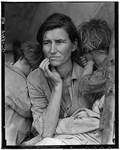
This photograph taken by Lange in 1936 was part of her work documenting the journeys of American migrant workers for looking work for Resettlement Adminstration, a government agency.
The picture was of Florence Owens Thompson and her children in Nipomo, California. The human suffering cut through the statistics of the time to a grim reality of everyday life for ordinary people.
As O’Neill says: “As much as anything, the arts define the times, sketching a portrait of a moment in the life of the nation and the world, marking a period in ways it comes to be viewed by people who live through it and by people who come after.
“But the tale of our times is mostly being told by our unwillingness to tell it”.