


Gender equality benefits boys as well as girls
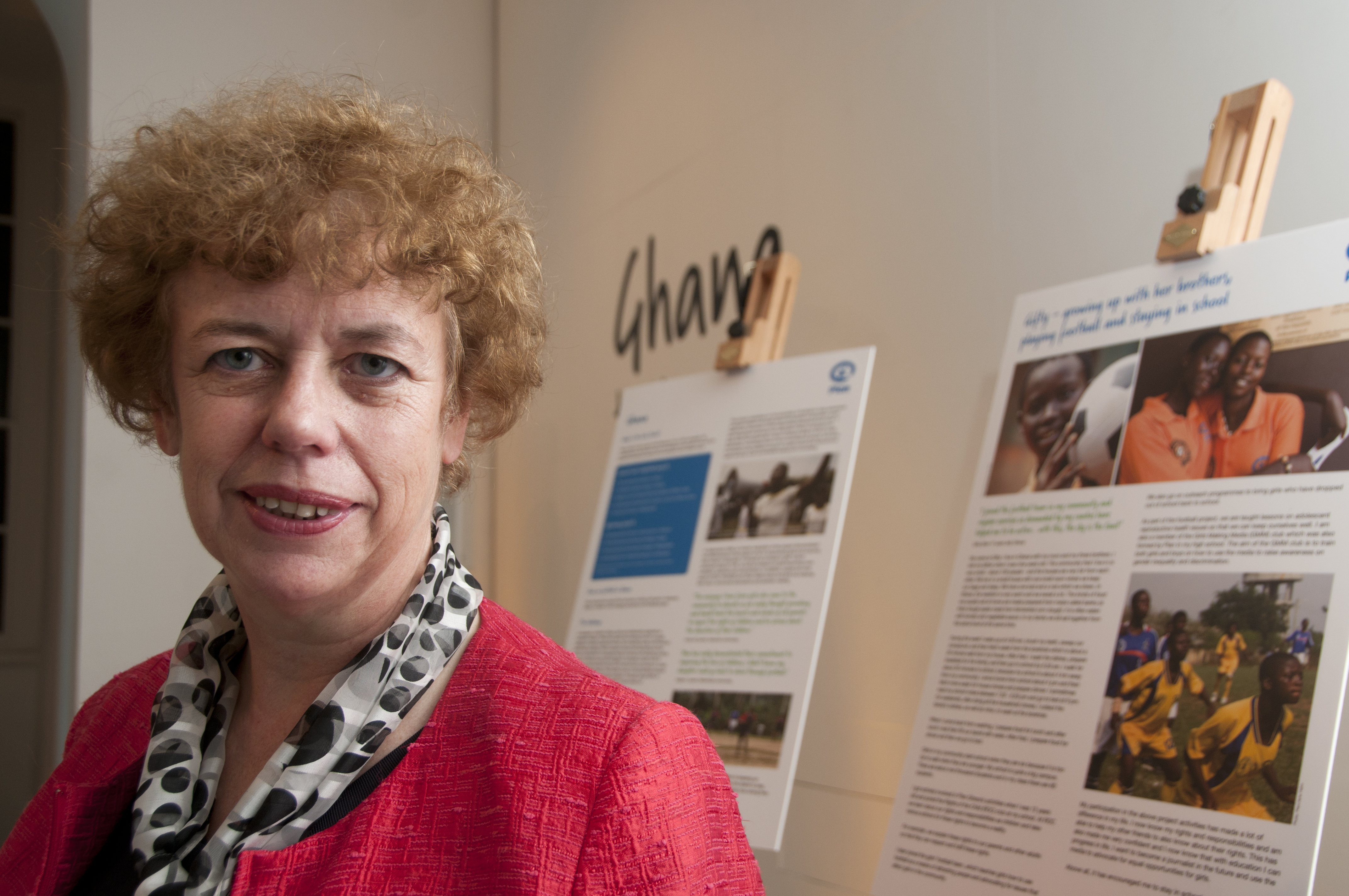
Marie Staunton, Plan CEO at the "Because I am a Girl" report launch
Ivana Davidovic
WVoN co-editor
Dumisani Rebombo was 15 when he raped a girl at his school in South Africa.
Twenty years later he decided to meet her and apologise.
Now, at 48, he is a gender activist, married with three children.
He says that as a boy he was poor and constantly ridiculed for it. His friends told him he could be a “real boy” if he would “discipline a girl.”
He was given beer to give him courage and remembers that his soccer team gave him a “standing ovation” after the news of the rape had spread.
“We live in a society that has known so much violence for so much time that it becomes normalised. There is a negative perception that if you don’t treat women as second-class citizens, they will take over the leadership,” he says.
“There are men who don’t rape but when they see these atrocities around them, they remain silent. When they speak out, we will win the battle.”
Rebombo’s story is just one of many featured in the “Because I am a Girl” annual report on the state of the world’s girls, launched by the children’s charity Plan earlier this week.
This year, the prevailing message is that gender equality is very much a boys’ issue too.
If we want to see a more equitable society, where women are free to reach their full potential, live independently and don’t fear constant violence, then engaging men in action and dialogue is essential.
Speaking at the launch, the Development Minister Stephen O’Brien stressed that “investing in girls and women has a transformative impact on growth, poverty reduction and the Millennium Development Goals, adding that the “UK has put girls and women at the heart of international development.”
Despite the tough economic climate, the Government is on course to meet the pledge of spending 0.7 per cent of GNI (gross national income) on overseas development by 2013.
In partnership with Plan, the Department for International Development has been setting up projects in Asia, the Caribbean and Africa which encourage men and boys to take a more proactive role towards an equal society.
UK aid is also spent on educational goals, like working towards putting one million more girls through school.
As this report highlights, gender inequalities do not happen in a vacuum, but as a result of an established system of power in which men wield most of it and the status quo is condoned by a large proportion of society.
From parental preference towards boys to expectations that girls will help out with housework, whilst their brothers are free to play with friends, Plan’s work in 57 countries has shown that gender stereotypes are passed on from generation to generation.
But it’s not just the girls who lose out.
“Girl are valued less in too many societies. They are paid less, they value themselves less, they expect less,” says Plan’s CEO Marie Staunton.
“We are finding that macho culture isn’t just dangerous for women. When we look at our work in the Americas we see that there are a lot of single-parent families and lots of incidents of violence against girls. But the situation is also bad for boys.”
“There are 200,000 missing boys in Brazil and they are missing because they have been pushed into risky behaviour. They die in violent incidents and there is a high incidence of suicide among adolescent boys.
“It is the same in Jamaica, sub-Saharan Africa and a number of countries where macho culture is killing young boys. So we are working towards gender equality which benefits boys as well as girls.”
Staunton says that their work on the ground and this research show that, together with their female peers, “many young men and boys are beginning to move beyond the straitjacket of traditional concepts of what it means to be a man.”
In 1979 Anita Ward’s “Ring my Bell” gave voice to female sexual satisfaction. Fast forward 30-odd years, men and boys in India have started to break the cycle of violence against women with a simple and effective action: ringing a doorbell.
When they would hear a man abusing a woman in a nearby home, they would ring the doorbell or find another way to interrupt the violence.
This campaign, known as Bell Bajao in Hindi, has won a Silver Lion Award at the Cannes Film Festival for the series of powerful print, radio and television public service announcements.
It has so far affected 130 million people and has become a metaphor for stopping abuse of any kind – making the once acceptable behaviour unacceptable.
Despite the many battles that have been won, the war for worldwide gender equality is still being fought. One particular issue, often neglected by the mainstream media, is crucial.
Child marriage.
Over 25,000 child brides are married every single day. That is more than 10 million annually. Marie Staunton believes that child marriage traps girls into a vicious circle of violence, poverty, deteriorating health and illiteracy.
“If you take that one particular violation of girls’ rights – the act of forced or child marriage – you notice that it means that girls are more likely to be subjected to sexual and other physical violence.
“They are also more likely to have babies younger, and we know that pregnancy is a leading cause of death in the developing world. And, of course, girls are also pulled out of education early. So, just that one violation has a huge negative domino effect.”
“At the moment one of our focuses is the upcoming Commonwealth Heads of Government meeting which is happening at the end of October.
“Twelve of the 20 countries with the highest rates of early and forced marriage are Commonwealth countries. Their leaders must take action.”
And taking action does work – slowly. Ten years ago Plan started working with communities in northern Bangladesh, where child marriage was widespread, although illegal.
They helped establish birth registration practice to monitor children’s ages more easily. Now local government representatives have stopped several illegal weddings from taking place and they are now debating whether to become an early-marriage-free area.
Staunton is is optimistic about the future.
“It takes a lot of time and a lot of confidence for men in power to take action – but change is possible. When you have trust, you can walk for miles together.”