


Pakistan’s PM praises women’s rights progress
 Summary of story from Associated Press of Pakistan, October 29, 2011
Speaking at the Commonwealth Heads of Government Meeting today, prime minister of Pakistan, Yusuf Gilani, said women in the country were being politically and economically empowered and playing an active role in nation building.
Addressing world leaders in Perth, Australia on the topic of “Women as Agents of Change”, Gilani spoke about the steps the government has taken for the advancement of women in the country.
These included increasing participation in the workforce and protecting women’s rights through legislation such as a harassment workplace bill enacted in 2010.
Other steps include the setting aside of 10 per cent of seats for women in all governmental jobs, while 30 per cent of seats in the parliament are reserved for women in addition to direct open elections.
Currently, there were 76 women legislators in the National Assembly out of 342 members, some who are in key positions such as Fahmeeda Mirza, speaker of the national assembly and Hina Rabbani Khar, foreign minister.
Pakistan’s voters elected the first woman as Prime Minister in the Muslim world, Benazir Bhutto, who was assassinated in December 2007 while campaigning for another election after coming back from exile in Dubai.
Gilani highlighted an initiative bearing her name, the Benazir Income Support Programme, which provides cash grants to female heads of poor households. To date, about Rs. 100 billion ($1.1mn) has been distributed to around 8.5 million families.
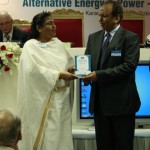
WVoN comment: During a trip to Karachi, Pakistan in March this year to report on metals and mining, I had the pleasure of meeting Engineer Senator Rukhsana Zuberi, chair of the Pakistan Engineering Council and Women in Energy (seen receiving an award in photo accompanying article).
She is a compelling promoter of smart energy usage, renewable energy development and greater participation of women in engineering.There is no doubt tremendous work to be done.
Pakistan was identified as one of the top five most dangerous countries for women in a report by the Thomson Reuters Foundation earlier this year.
The ranking, based on a poll of gender experts, measures major threats to the welfare of women and girls: “sexual violence; non-sexual violence; cultural or religious factors; discrimination and lack of access to resources; and trafficking.”
The study found that women in Pakistan earn about 80 percent less than men, and 90 percent of them experience domestic violence in their lifetimes.
Yet, meeting women like Zuberi however, does impress upon me that there are efforts on the ground which reinforce some of the statements found in Gilani’s speech.