


Through the lens of violence
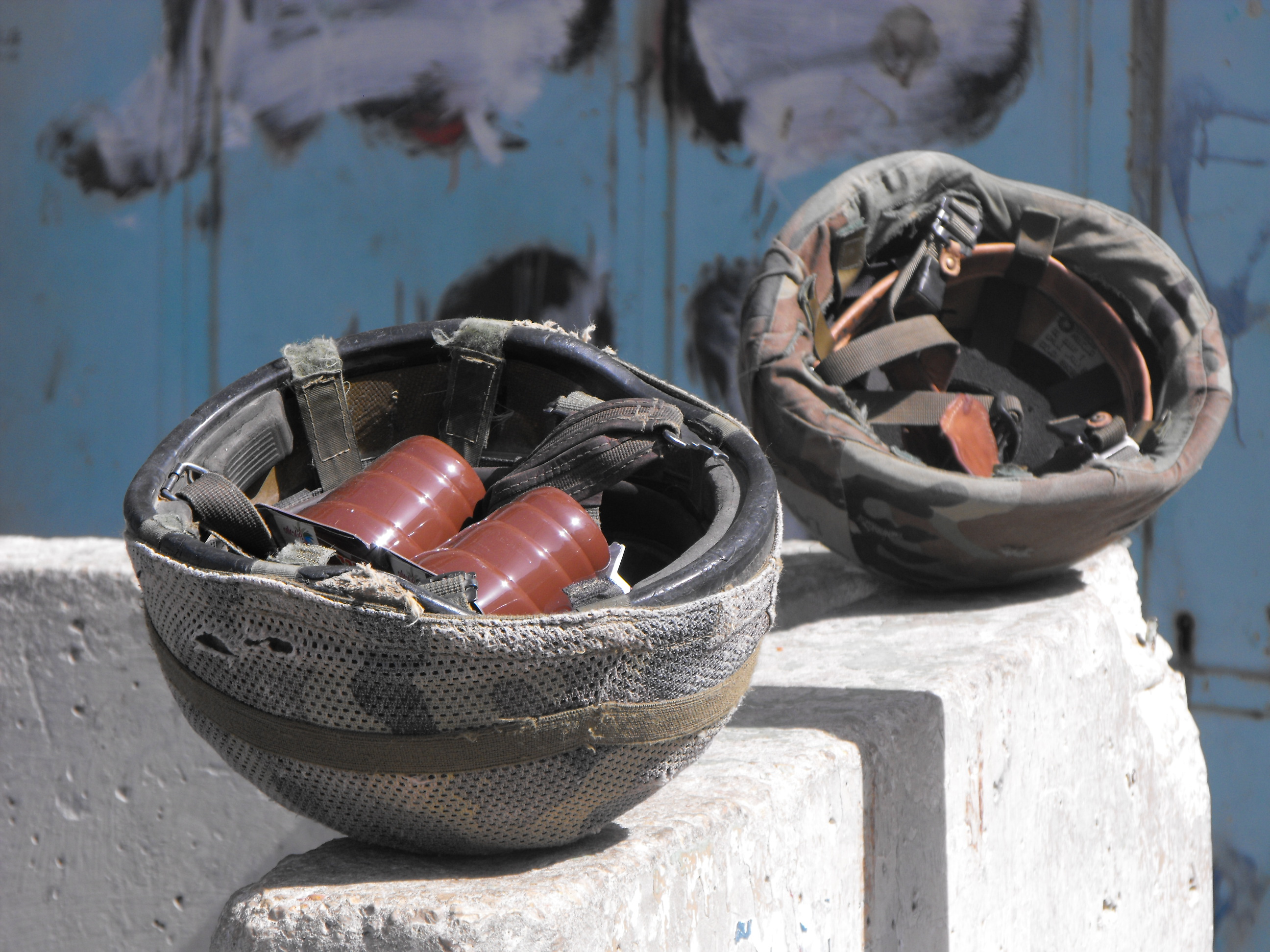
Soldiers' helmets in Hebron, 2010
Sarah Cheverton
WVoN co-editor
Janina Struk’s most recent book focuses the lens on the role of photography in shaping our perceptions of war.
At the same time, ‘Private Pictures: Soldiers’ Inside View of War’ raises some interesting questions about the nature of violence more broadly, including violence against women.
Private Pictures is a collection of photographs taken by soldiers over the last century.
And as Struk says on her website: “They are essentially private, intended for families and friends, or for the soldiers themselves.”
The book includes the use of photography to reveal the propaganda of the First and Second World Wars.
It follows soldiers up to the present day, including photographs taken by Israeli soldiers and used by organisations such as Breaking the Silence, as Struk says in the book, to “confront Israeli society with the photographic evidence of what they call the ‘terrible moral price’ of occupation and asking it to judge for itself.”
One of the key focuses of the book is to question why soldiers take these pictures, photos that frequently depict acts of extreme cruelty, torture and death.
It’s a relevant question, and one that everyone asked who remember the unfolding news story of the grisly photos taken by US troops in Abu Ghraib, many of which showed women soldiers taking the lead in acts of abuse and torture.
In all its forms, violence seems to require that the perpetrator reduces his or her victim, even if only temporarily, to something less than human – an ‘other’ against whom the most terrible acts of inhumanity seem to the perpetrator somehow acceptable, even somehow, necessary.
I have spent the last month reading and writing about the occupation of Palestine, where the concept of ‘otherness’ poisons not just one nation, but two, feeding fear, violence and consistent breaches of human rights.
I have also been learning about violence against women with the London Metropolitan University’s Child and Women’s Abuse Studies Unit (CWASU).
The theme of ‘otherness’ runs through both subjects.
For women caught in such conflicts – as this year’s 16 Days of Activism’s theme of militarism highlights – being defined as ‘other’ can have terrifying consequences.
Women are often caught in a double bind of ‘otherness’, first as ‘the enemy other’ in a conflict and then as ‘the female other’.
The consequences of this double bind are frequently devastating, as the pervasive use of rape in the Congo illustrates.
But often it is even more subtle and often indirect, such as the exclusion of women from peace talks in Afghanistan, or the poverty experienced by many Palestinian women as a result of losing husbands to indefinite imprisonment or even death.
The damage of our construction of ‘otherness’ does not only apply to war, but extends far beyond, into the fabric of our daily lives.
The man who raises his hand to his girlfriend or wife does not view her as an equal, as the same as him, any more than the man who rapes his date, or the man yelling sexual abuse at women in the street.
When, as human beings, we allow the differences between us – differences of geography, ethnicity, religion, or sex – to overshadow that which unites us, we open the door to the possibility of violence.
The ability – and permission – to see another human being as ‘other’ is why we see women soldiers laughing over corpses or the torture of Iraqi prisoners in the photographs from Abu Ghraib.
But it also why we see cadets filming sex without the consent of their partner for the titillation of other men.
It is embedded in the way we construct our relationships to one another as nations, and as men and women, and every time we let ‘otherness’ overpower union, it demeans us all.