


Last Night of the Proms baton passes to a woman
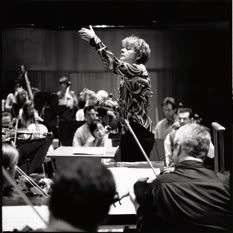 After 118 years of glorious music making, the Last Night of the Proms will at last be directed by a woman.
Every year, thousands upon thousands of people flock to London from all over the globe to participate in what the English call the biggest and brightest classical music festival in the world – the Proms.
This year’s season features a number of ‘firsts’ for the Proms – for the first time, there is a free evening Prom, an Urban Classic Prom, a visit from the tour de force that is the National Youth Orchestra of the United States of America and a performance of Wagner’s complete Ring cycle.
Great news for Prom-ites, indeed.
But making perhaps even bigger musical history is Marin Alsop, American conductor and Musical Director of the Baltimore Symphony Orchestra.
Alsop has made many appearances at the grand old Albert Hall, but this year she will become the first woman ever to direct the pomp and circumstance that is the Last Night.
A former pupil of the legendary Leonard Bernstein, she has notched up a few firsts of her own.
She was the first woman to be awarded the Koussevitzky Conducting Prize from the Tanglewood Music Centre, and the first woman to head up a full time major American orchestra, although years of graft and commitment in the UK failed to secure her a top job here.
But now she has the Last Night of the Proms, or LNOTP as it has become affectionately known.
The BBC announced their concert programme and the news of Alsop’s historical appearance last week, but Director of the BBC Proms, Roger Wright, was quick to make it clear that her gender had nothing to do with her selection.
He said, ‘Marin hasn’t been chosen because she is a woman conductor. She knows and loves the Proms and has a very good relationship with the BBC Symphony Orchestra. We’ve built a programme for the Last Night that plays to her strengths.’
Wright also referred to the historical void of female conductors, saying ‘There are some renowned orchestras which are male dominated.
‘There are issues about the sort of schooling conductors go through and how family roles have been divided traditionally; role models have been slow to come through.
‘It’s great that we now have a number of very good women conductors. Marin is one of five women out of around 50 conductors at this year’s Proms. But the BBC can only solve so many problems of the world.’
Well, it only took them 118 years.
Regardless, Roger Wright has a point when he refers to ‘male-dominated’ orchestras.
As unbelievable as it may seem, one of the ‘renowned’ orchestras he referred to, which incidentally is also one of the best known orchestras in the world, is the Vienna Philharmonic, which only began admitting women full-time to their ranks in 1997. And that was only after a protest in America. To this day, there are still only six full-time female members of the orchestra.
Their New Year concert is billed as the biggest concert date of the year – watched on television by as many as 60 million viewers in 81 countries
With perhaps the biggest following in the world, the Vienna Philharmonic paints a bleak picture for what is still acceptable – sexism in the guise of art.
Sadly, institutional sexism is something that has plagued the concert halls of classical music since conductors first raised their batons.
Historically, the world of classical music has always been a hostile environment for women – conductors, composers and performers alike, although there are happily more female soloists now than ever before.
But the rank and file of orchestras in general is still pretty bereft of women, especially in European orchestras.
Only fourteen per cent of the Berlin Philharmonic are female, the Czech Philharmonic around twelve per cent, the Dresden Philharmonic twenty eight per cent and the London Symphony Orchestra twenty nine per cent, although other British orchestras do rather better, as do American orchestras.
But the number of female conductors remains low.
Indeed, Marin Alsop has few female peers; Simone Young, music director of Opera Australia and Andrea Quinn, music director of New York City Ballet are the two most obvious.
So all eyes will be on Alsop on the LNOTP, not just because of her incredible musical energy, talent and experience, but because she is somewhat of an anomaly in her world, achieving success in what remains stubbornly a male-dominated profession.
Of her appointment to the LNOTP, she says on her website: ‘I am extraordinarily proud to be the “first” but I am also shocked by the fact that in the 21st century there can still be “firsts” for women!
‘While gender seems an inconsequential and irrelevant attribute to me, I also understand what an incredible opportunity it is to be a “first woman” in any pursuit.
‘I am in a position now to create opportunities for the next generations of women and I take that responsibility very seriously.’
She is not, however, unaware of the sexist prejudice that still exists in her field.
‘The hardest thing for me is always to get a big sound from the orchestra without being very demanding or apologising.
‘As a woman, if you’re too aggressive people think, “She’s so overpowering. What’s she on us for?” But if a man does the same gesture, it’s regarded as strong and virile.’
But given the challenges she has faced, her perspective remains refreshingly, and somewhat surprisingly, down to earth.
‘When people ask me, “What’s it like to be a woman conductor?” I have no perspective. I’ve always been a woman conductor. I have never been, say, a lizard conductor.’
She sounds great, doesn’t she?
And of the future?
‘There are certainly more women going into the field these days. When I teach it’s generally a 50/50 ratio of men to women and I don’t think women hesitate as much to consider a career as a conductor these days.
‘As far as opportunities, I would imagine that there are more now than ever before, but it would be naive not to notice that there are no women music directors of any major orchestras in the world…’
For whatever reason, Marin Alsop is definitely worth a watch.
She is exuberant, she is musical, she is talented and she engages her audiences.
And she loves being a woman conductor.
‘Frequently women tell me that they feel empowered and can relate very directly with a woman conducting.
‘And at the Baltimore Symphony Orchestra’s opening gala a female journalist told me that the woman seated next to her, dressed is a formal gown, stood up and high-fived her at the end of the concert. Now that is cool.’
I wonder what the founder and creator of the Proms all those years ago would think? Would he approve?
I think Sir Henry would.