


Exploring the demand for prostitution in Lebanon
 What male buyers say about their motives, practices and perceptions.
Lebanon has long been known as a sex tourism capital in the Middle East, but it is now – also – an industry which is exploiting Syrian refugees.
The results of a study examining the prostitution behaviour of male buyers of sexual acts is the first publication of a larger research study on prostitution and human trafficking in Lebanon.
The research was carried out by KAFA (enough) Violence & Exploitation, a feminist, secular, Lebanese, non profit, nongovernmental civil society organisation that aims to create a society free of the social, economic and legal patriarchal structures that discriminate against women.
It is clear from the research findings that prostitution does not establish a contractual relationship between two equal parties where a service is rendered in exchange for money.
What is in fact established is an exploitative relationship, which is normalised by a complex scheme of patriarchal justifications and rationalisations presented by male buyers as truths.
Prostitution is about male sexuality, and is justified by male buyers of sexual acts as a necessity for satiating their sexual impulses and needs, and for maintaining public order.
Without the possibility of buying sexual acts, men claim they would become uncontrollable and society would suffer, particularly women not in prostitution.
According to the majority of the interviewed male buyers, prostitution reduces the rape of women who are not engaged in prostitution, and prevents other forms of abuse.
Many male buyers claim that it is easy and convenient to use women in prostitution as opposed to going through the hassle of dating and commitment.
Prostitution is also justified as a means to seek variety, leisure, entertainment, discovery, and experimentation, and as paving the way to adulthood and manhood.
These patriarchal assumptions about men’s sexuality institutionalise prostitution and normalise it as a viable “profession” for women that they may “choose” and even “like.
Men rationalise prostitution through the act of paying money.
The vast majority of the interviewed buyers believed that when a man pays money for a sexual act, the woman in prostitution is required to answer to all his wishes and desires.
By buying, men not only commodify the woman and consider her as an object – just like any other product on the market – but they also buy the right to control the woman for the duration of the encounter and to exploit her.
In this “transaction”, men are in a position of power where they dictate matters and control the real choices.
It is in this context and this reality that forces women to develop different self defence mechanisms and tactics to reduce, often unsuccessfully, the inevitable harm generated by the exploitative nature of prostitution.
Such justifications and rationalisations allow men buyers, despite their awareness of the deplorable conditions for women in prostitution, to continue to purchase and exploit women, while their demand fosters and causes the expansion of this profitable industry.
The prostitution buyers in the study did not change their behaviour despite being fully aware that is often difficult socioeconomic conditions and an acute need for money that lead women to enter into prostitution.
Nor did their awareness of the level of control and abuse exercised by pimps, traffickers, or clients impact in any way on their choice to purchase and exploit women through different prostitution activities in Lebanon.
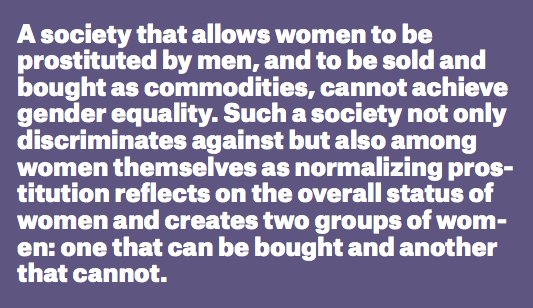
A society that allows women to be prostituted by men, and to be sold and bought as commodities, cannot achieve gender equality.
Such a society not only discriminates against women but also among women themselves; normalising prostitution reflects on the overall status of women and creates two groups of women: one that can be bought and another that cannot.
This same society cannot also effectively combat sex trafficking.
Prostitution and sex trafficking are closely linked; not only are they driven by the same demand and thrive on the vulnerability of women, but they share the same end purpose of sexual exploitation of women.
Sex trafficking is just a process of delivering women into sexual exploitation.
According to the UN Trafficking Protocol definition, sex trafficking is a way of recruiting, receiving, or transferring of a person though certain means (such as the abuse of vulnerability of the person) for the sole end purpose of sexually exploiting her, and prostitution, as seen in this study, is the most flagrant example.
To properly address prostitution and sex trafficking while preventing and combating their root causes, Lebanon should counter the demand for prostituted women and challenge current conceptions of prostitution and male sexuality.
The following actions are recommended:
Amend the Penal Code to criminalise the buying of sexual acts and introduce change and counselling programs for buyers;
Challenge attitudes that normalise prostitution by outlining the harms of the sex industry, and address the culture that fuels prostitution such as pornography and the sexualisation of women and girls in media and popular culture.
Carry out accountability and deterrence campaigns outlining the responsibility of buyers in creating and fuelling sex trafficking and prostitution, and depicting the realities of the victims.
Conduct preventive and education programs targeting adolescents and young men who are potentially approaching their first sexual experience;
Sensitise law enforcement officers and the judiciary on prostitution and sex trafficking and their interlinkages, on the consequences for women in prostitution and society at large, and on the role of the buyers in the creation and retaining of prostitution markets in Lebanon.
In addition to tackling the demand side of prostitution and sex trafficking, a holistic approach is warranted which addresses the industry and the persons exploited.
For this, the following actions are recommended:
Repeal all criminal and administrative measures that penalise persons practicing prostitution as they are victims of a serious form of violence and exploitation, and their human rights are violated;
Abolish the Artist Visa scheme and all other regulations and policies that facilitate prostitution directly or indirectly;
Criminalise all aspects of the prostitution industry including the persons and businesses involved such as the “Super Nightclub” sector; and
Establish adequately funded exit programs and specialised protection programs for victims of sex trafficking and prostitution, and individuals at risk.
To read ‘Exploring the demand for prostitution: What male buyers say about their motives, practices and perceptions’ in full, click here.
Prostitution is one of the topics that sharply divide the feminist movement.
The debate is polarised: some groups argue that prostitution could be liberating and empowering for women, while other groups understand prostitution as intrinsically exploitative and oppressive to those women, who are or have been involved.
Like many of us, long before they initiated this research, KAFA team members were exposed to this debate.
It took time, much reading, and discussions for KAFA team members to come to a clear stance on prostitution: prostitution is a highly gendered violation that incarnates and reinforces patriarchy. It constitutes a form of violence against women, and is an infringement of women’s basic rights to personal security and human dignity.