


It is still a man’s world: UK 2018
 Many young women still have more limited opportunities than their male counterparts.
The Young Women’s Trust’s 2018 annual survey, It’s (still) a Rich Man’s World, once again shows that young women remain more likely than young men to be affected by job insecurity, money worries and debt.
The Young Women’s Trust supports and represents women aged 16-30 struggling to live on low or no pay in England and Wales and who are at risk of being trapped in poverty.
The report, which has been based on the Trust’s annual Populus Data Solutions poll of more than 4,010 18-30 year-olds in England and Wales and 1,105 54-72 year-olds in England and Wales shows that millions of young women are being let down in workplace.
Women bear the brunt of low pay, with debt levels increasing, and more than a quarter of young women said their financial situation has worsened in the past year; gender discrimination is (still) rife; and young women’s mental health concerns are skyrocketing.
The report also showed that sexual harassment is still not being dealt with: 15 per cent of young women (some 800,000 young women), have been sexually harassed at work and not reported it – double the number of women who have experienced it and reported it (eight per cent); a third of young women (32 per cent) say they don’t know how to report sexual harassment; and one in five young women (18 per cent) say that they are too scared to report sexual harassment at work and a quarter of young women (24 per cent) would be reluctant to report sexual harassment for fear of losing their job, or fear of being given fewer hours (17 per cent).
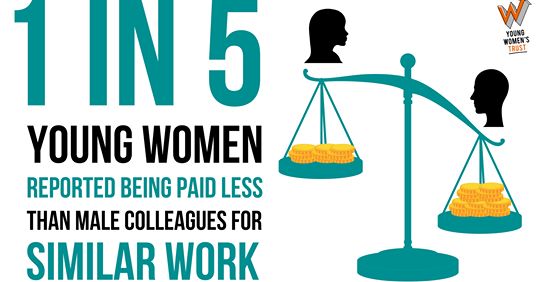
And employers are ignoring gender pay gaps: one in five young women (19 per cent – or more than a million) say they are illegally paid less than their male colleagues for the same or similar work, rising to one in four (25 per cent) for those aged 25-30; and 55 per cent of young women are disappointed by their employer’s efforts to tackle the gender pay gap but more than half (53 per cent) say they don’t have the confidence to challenge their boss on the issue.
One hundred years ago the first women got the vote, but those who were aged under 30 or poor remained locked out of voting for another decade.
While all women in the UK now have equal voting rights, Young Women’s Trust’s annual survey has found that in other respects many young women still have more limited opportunities than their male counterparts – with career prospects, spending power and wellbeing trailing behind those of young men.
If the year 2018 is to be a turning point for women’s equality and not just a footnote in history, then it’s clear that we need deeds, not just words.
We need to be impatient for change: a lot has been achieved in the last 100 years, but with the current rate of progress women’s equality remains beyond reach.
A concerted effort is therefore needed from the government and from employers to provide young people with security and hope for the future, redress gender inequality at work and help manage the growing mental health crisis among young people.
This effort, Young Women’s Trust’s research suggests, needs to be particularly focused on young women, especially those from lower socio-economic groups who are the most likely to be struggling financially and emotionally.
To read the full report, please click here.
Please forward this to your MP and ask when they intend to effectively address these issues.
You could also write to your MP and ask them to forward this report to The Chancellor of the Exchequer, Philip Hammond; the Secretary of State for Business, Energy and Industrial Strategy, Greg Clark MP; the Secretary of State for Work and Pensions, Esther McVey MP; and the Minister for Women and Equalities, Penny Mordaunt MP, along with a letter – written by your MP – asking if, how and when they are going to effectively address these issues.