


Judge says Assange to be extradited to Sweden
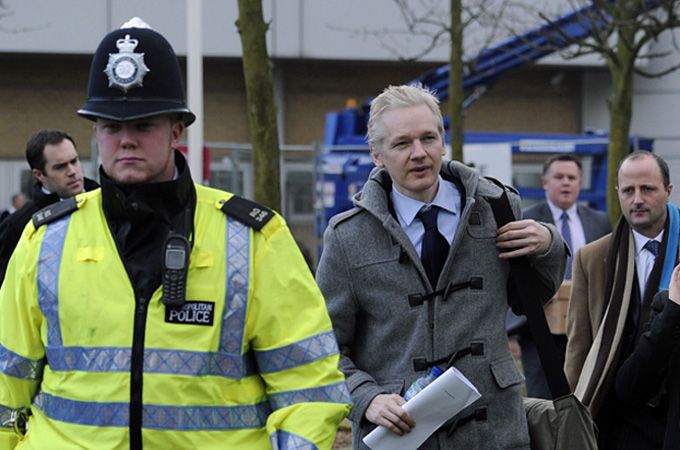 Summary of coverage 24.2.11 from Al Jazeera, BBC, The Nation and The Guardian, (who also chose the most John Inman-like image of Assange I’ve seen yet to accompany their coverage).
So, after weeks of speculation and endless media storms, a judge today ruled that Julian Assange will be extradited to Sweden to face sexual assault charges.
District Judge Howard Riddle ruled that the extradition did not breach Julian Assange’s human rights before releasing him on the same bail as he was granted in December.
According to the BBC: “Judge Riddle dismissed the argument that Mr Assange would not receive a fair trial in Sweden that had been made by his lawyers during the two-and-a-half-day hearing earlier this month.”
Assange was quick to attack what he describes as “the rubber stamp process” of “a European arrest warrant system (run) amok.”
A limited transcript of Assange’s comments following the ruling can be found at The Guardian.
“The scrutiny of the European arrest warrant system needs to begin now,” he continued, “It cannot be the case that filling two pages with someone’s name and a suspicion – not a charge – can lead to their extradition to one of 26 European nations.”
“Three people a day are being extradited from the UK under a rubber stamp process,” Assange added.
Regardless of personal views on Assange – and I know there are a diversity of views on this in the feminist community – I often wonder if there has ever been an international effort on this scale to pursue an alleged perpetrator of rape and sexual assault.
It would seem Assange wonders the same thing.
“Why is it that I … am subject to a $360,000 bail?” He demanded to the press today, “Why is it that I am kept under electronic house arrest when I have not even been charged in any country and I have never been a fugitive?”
“On February 20 the US ambassador to the UK told the BBC that the US, in relation to its ongoing investigations and attempts to charge me with espionage, would have to see what happened here today.”
“Why is that? What does the United States have to do with a Swedish extradition process?”
Assange’s mother, Christine, referred to the court order for Julian’s extradition as ‘political and legal gang rape’, according to the Australian Associated Press, reported in Al Jazeera.
“The greatest fear I have is that the Western world in its effort to shut up someone who’s telling the truth to the people of their countries will breach every piece of legislation in order to get him and will co-operate across borders to do so,” she added.
And the aura of suspicion around the hearings don’t end with Assange.
The Nation report today that those international guardians of free speech, PayPal, have frozen the account of the Bradley Manning Support Network.
The Network has been raising funds for US Army Pfc Bradley Manning (see WVoN story), who has now been imprisoned for 274 days due to allegations that he passed classified data to Wikileaks. He is currently awaiting trial for court martial and faces a maximum sentence of 52 years.
The freezing of his account raises more concerns for Wikileaks supporters about the shadowy exercise of power that seems to dominate these hearings, and Wikileaks itself.
Whatever your thoughts on this trial, you still have a few days to join in the debate. The High Court will hear Julian Assange’s appeal next week.
“We are still hopeful that the matter can be resolved in this country,” Assange’s lawyer, Mark Stephens is quoted as saying in The Guardian.
“We remain optimistic of our chances on appeal.”