


High Stakes – WVoN interview with Oxfam
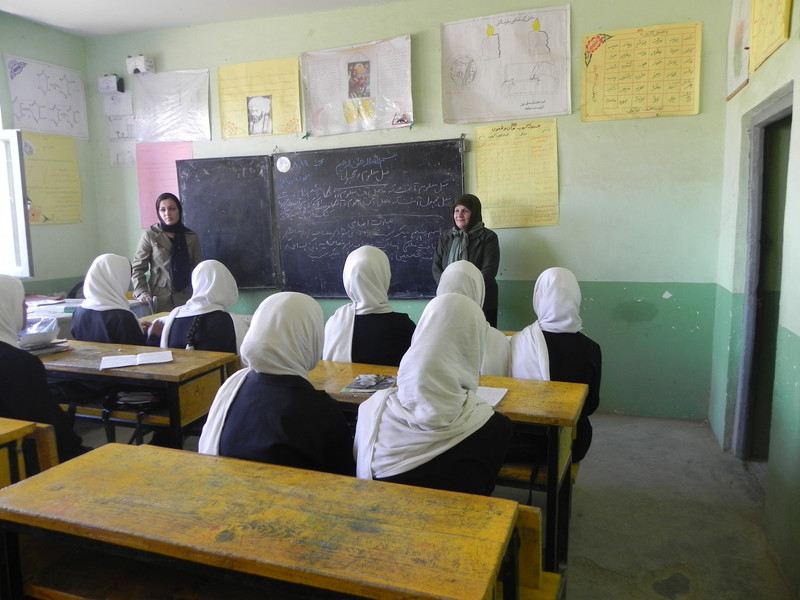
Principal Nafeesa, of at Hashim-e Barat High School for Girls, Mazar-e-Sharif, northern Afghanistan. Image courtesy of Oxfam.
Oxfam has today published its report – High Stakes: Girls Education in Afghanistan – setting out the need for a new approach from donors and government to girls’ education in order to hold onto the gains that have been made since the fall of the Taliban.
You can read more about the report in today’s WVoN article.
Sarah Cheverton also spoke to Oxfam’s Rebecca Wynn about the importance of today’s report, and about the issues affecting the education of Afghan girls and women today.
SC: The production of this report was clearly a hugely collaborative project, with over a dozen other organizations working with Oxfam. Can you tell me a little bit about how Oxfam was involved?
RW: Oxfam led on the report, it was the idea of the researcher and writer, Ashley Jackson. But obviously, one person can’t interview over 600 people, and we knew that it was really important to work with established NGOs on the ground, which had existing relationships with local communities.
Working directly with Afghan women and men is vital to us in projects like these. We need to hear their voices, and we couldn’t have done it without them.
Many people might not immediately think of Oxfam as being involved in Afghanistan, and I see that the report refers to research Oxfam undertook there in 2006. Is that fairly typical of the sort of work Oxfam has undertaken in Afghanistan?
Working in Afghanistan has been a strong priority for us for the last five years. Afghanistan is one of the poorest countries in the world and so we’ve been very, very involved there. We believe it’s very important to bang the drum for the people of Afghanistan.
Oxfam has been working across two areas, one is civilian protection and the other is aid effectiveness.
In 2009, we published a research report called ‘The Cost of War’, which was another collaborative effort with NGOs working in Afghanistan. As the title implies, that report was centred on civilian protection.
High Stakes, the report we’re launching today, relates to the other strand of our work, which is aid effectiveness. Essentially, it’s about making sure that the aid sent to Afghanistan is being spent in the right way, in this case, particularly looking at the aid sent to improve access to education for girls and women.
One of the issues discussed in the report is how some aid projects get caught up in the conflict. For example, the report talks about the perception in local communities that schools are more likely to be attacked if they were built by or have a relationship with Provincial Reconstruction Teams, or PRTs.
[Note: PRTs are part of the system of militarized aid in Afghanistan. You can find out more about them by reading Oxfam’s report Quick Impact, Quick Collapse – The dangers of militarized aid in Afghanistan.]
So security is a significant issue, and feelings of insecurity in local communities have a ripple effect – often it doesn’t just affect the number of girls attending one school, but a whole area.
That said, it’s not just about security, there are other factors that affect girls’ access to education.
The report really helped me to realised that while there has been such a stunning increase in the number of schools, the number of teachers just hasn’t been keeping pace. This is particularly true of the number of female teachers. Female teachers are desperately needed, particularly in rural areas, because most female teachers are concentrated in urban areas.
Something else that surprised me was the number of schools that have no buildings. Students are learning outside, or in tents. The winters in Afghanistan are absolutely freezing, which means that for those students, access to education is stalled again.
Many of our readers are active campaigners for international women’s rights. What can they do in the UK and beyond to support the aims and recommendations of this report?
Helping Oxfam to raise awareness is hugely important, for example writing or talking to your MPs.
We’ll be launching a new campaign at the end of March called ‘Together Afghanistan’, and that will focus on letter writing campaigns and petitions, building on many of the issues raised in this report. I’ll keep WVoN posted!
The report makes a wide number of recommendations to improve the availability, reach and quality of education in Afghanistan. Are there any particular factors that could potentially impede or facilitate those recommendations?
I think the role of peace talks are crucial. As the report says, we have to make sure that girls’ access to education is not traded away as part of peace negotiations.
Yes, the report actually closes with that recommendation, saying that “The future of Afghanistan depends on it.” This seems to tie in to the importance of women’s representation in peace negotiations, which is an issue very close to WVoN’s heart.
That’s right. I think it’s an absolutely key recommendation for girls’ and women’s access to education. Everything hinges on it, so it’s a significant risk. We can lose the gains that have been made by having a peace deal that trades women’s rights away. So we need to ensure that doesn’t happen.
There are so many inspiring women in Afghanistan. I know an Afghan woman who came to the UK to study to become an economist. We need to make sure that skilled and able Afghan women have the opportunity to decide their futures, whatever they want to be.
How can the UN and other donors best respond to ensure that access to education is not traded away?
I think by raising the issue now with the Afghan government, lobbying and raising awareness.
Including lobbying your MP?
Absolutely, but also by working together with Afghan women.
The picture that emerges in the report of girls’ access to education is a very complex one, and the report underlines several times the importance of a co-ordinated and holistic approach, rather than dealing with any of these individual factors in isolation. How hopeful is Oxfam, in this context, about the future of girls’ education in Afghanistan?
We have to be hopeful, we have to keep pushing the message home about how important this is.
And we have to remember that there’s already been a very real shift in Afghanistan. More and more parents are sending their daughters to school and want their daughters to be educated.
They have hope for the future, and so should we.